
In This Article
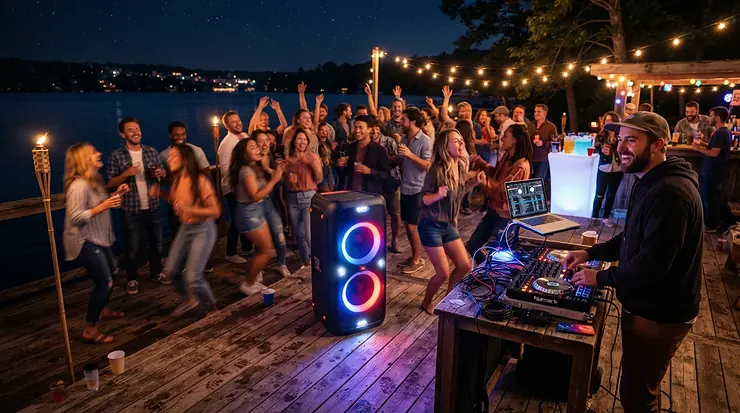
A large party speaker with wheels for backyard use is a high-output Bluetooth speaker built into a rolling cabinet with a pull-up handle. The wheels let you move 35 to 70 pounds of sound across patios and lawns without lifting, while real RMS wattage keeps the music clear across a typical yard.
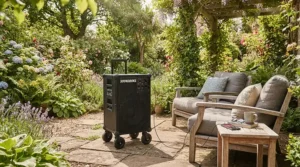
Picture the scene. It’s 4:45 p.m., guests arrive at six, and the speaker you swore would “totally fill the yard” is on a garage shelf, forty-odd pounds of plastic and good intentions. Now you have to haul it past the grill, up a step, and across a lawn that suddenly feels a mile wide. That is the exact problem wheels solve.
Here’s the catch, though. Wheels alone don’t make a good party speaker. A cabinet can glide like a dream and still sound like a tin can in a canyon. So this guide pairs hard specs with plain-English analysis: what the power rating means, how handle design changes your evening, and which model suits which kind of yard. Where a number can’t be verified, I’ll say so instead of padding it.
We’ll also untangle the difference between RMS and peak watts. That one distinction decides whether you’re buying genuinely loud or just loud-looking packaging.
Everything below comes from manufacturer specs, retailer listings, and published reviews gathered in late 2026. Prices are ballpark ranges only, so always check the current price before you buy.
Quick Comparison: Best Large Party Speaker With Wheels for Backyard Parties
| Product | Output | Weight | Power | Best For |
|---|---|---|---|---|
| Monster Rockin’ Roller 360 | 240W listed (type unclear) | Not verified | Battery | Budget buyers who want to roll |
| PRORECK Party 12 | 150W RMS reported | About 60 lbs (shipped combo) | AC plug-in | Big lawns on a tight budget |
| JBL PartyBox Stage 320 | 240W RMS | About 36 lbs | Swappable battery, up to 18 hrs | Balanced, easy-to-move all-rounder |
| JBL PartyBox 330 | 280W RMS | About 38 lbs | Swappable battery, up to 18 hrs | Newer mid-weight with locking handle |
| JBL PartyBox 520 | 400W RMS | About 56 lbs | Swappable battery, up to 15 hrs | Larger yards without going huge |
| Sony ULT Tower 9 | RMS not published | About 65 lbs | Built-in battery, up to 25 hrs | Long nights and karaoke crowds |
| JBL PartyBox 720 | 800W RMS | About 68 lbs | Dual swappable batteries, up to 15 hrs | The biggest yards and crowds |
Looking at the table, the JBL PartyBox 520 is where output and portability start to feel like a fair trade. The JBL PartyBox Stage 320 and JBL PartyBox 330 are the easiest to live with if you move your speaker often. Anyone chasing sheer volume should look at the JBL PartyBox 720, but its 68-pound frame means you’ll want a flat path from storage to patio. Budget buyers should note that the Monster Rockin’ Roller 360 lists a big number without saying what kind of watts they are, a puzzle we’ll solve in the RMS section.
Weights come from manufacturer or retailer spec sheets. Treat them as approximate, since packaging and battery inclusion vary by listing.
💬 Just one click — help others make better buying decisions too!😊
Top 7 Large Party Speakers With Wheels for Backyard Parties: Expert Analysis
I’ve ordered these from budget to premium so you can find your price lane first, then compare within it.
1. Monster Rockin’ Roller 360 — budget roller with oversized 5-inch wheels
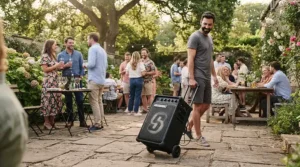
The wheels are the headline here, and they matter more than any number on the box. Comparison listings describe oversized 5-inch wheels and a telescoping handle, plus IPX4 weather resistance, a Qi wireless charging pad, a USB port, and wireless pairing with a second speaker.
In practice, bigger-diameter wheels roll over lawn edges, gravel seams, and patio cracks that stall tiny casters. The Qi pad also means guests stop hunting for chargers. The catch is the 240W figure. The listings I reviewed don’t say whether it is RMS or peak, and the difference can be a factor of two or more. On paper, I’d treat it as a small-to-medium yard speaker until proven otherwise.
Review sentiment is encouraging. The Walmart listing shows roughly 4.5 stars across about 486 reviews, and one roundup praises the rugged wheels and a handle it found sturdier than JBL’s telescopic designs. One buyer comment I found framed it as half the price and half the polish of a premium rival, which is a fair summary of the trade-off.
Pros:
- ✅ Oversized wheels handle uneven ground
- ✅ Sturdy telescoping handle
- ✅ Qi charging pad and USB port included
Cons:
- ❌ Power rating type isn’t clearly specified
- ❌ Trails pricier rivals in polish, per buyer chatter
Price: roughly the $250-$300 range. Verdict: strong value if mobility beats fidelity, so check current price.
2. PRORECK Party 12 — two-speaker PA combo for big-lawn value
This one is less a party speaker than a small PA system wearing party clothes. You get an active and a passive 12-inch speaker, stands, a wired microphone, and a remote, with Bluetooth, USB, SD, and FM playback plus XLR and quarter-inch mic inputs.
The 12-inch woofer and 1.35-inch titanium compression driver are the interesting bits. A dedicated horn-style driver means vocals cut through crowd chatter better than a typical all-in-one box. Notice the listing mess, though: one retailer lists 1000W peak with 150W RMS, another claims 1800W peak. The peak number wobbles, which is exactly why you should anchor on the 150W RMS wattage.
Because it plugs into the wall, the PRORECK Party 12 suits a backyard with an outdoor outlet or a long, safe extension cord. Reviewers praise its power, clarity, and value. The recurring complaint is that even with wheels, the combo’s weight and size are hard to manage alone. Its Walmart listing shows about 4.7 stars from 34 ratings, a small sample.
Pros:
- ✅ Stands, mic, and remote included
- ✅ Horn-style driver helps vocals cut through
- ✅ Very strong value for a two-speaker combo
Cons:
- ❌ Needs AC power for the whole party
- ❌ Awkward to move solo despite wheels
Price: roughly the $250-$300 range. Verdict: the best bang for the buck if an outlet is nearby.
3. JBL PartyBox Stage 320 — swappable battery at a sensible weight
JBL’s manual lists 240W RMS (IEC60268), two 6.5-inch woofers, two 1-inch tweeters, a 40 Hz to 20 kHz response, and up to 18 hours of playtime from a replaceable battery. The telescopic handle and wide wheels do the heavy lifting at roughly 36 pounds.
What does that mean on a Saturday? Two 6.5-inch woofers won’t shake the neighbors’ windows, but they deliver clean, punchy output for a typical suburban yard. The replaceable battery is the sleeper feature: buy a spare and your party stops depending on a wall outlet. Auracast support lets you link multiple compatible speakers if one isn’t enough.
Review roundups call its wheels and handle noticeably better than the older PartyBox 310’s setup, and one retail aggregate shows about 4.1 stars from over 1,600 reviews. A stockist’s pros-and-cons list flags its bulky footprint in a car trunk or closet.
Pros:
- ✅ Replaceable battery with up to 18 hours
- ✅ Wide wheels and a real telescopic handle
- ✅ Dual mic and guitar inputs, Auracast pairing
Cons:
- ❌ Takes real space in a trunk or closet
- ❌ Only IPX4 splash resistance, not waterproof
Price: ballpark $450-$600, since my research found no single reliable US figure. Verdict: a safe, balanced pick, so check current price.
4. JBL PartyBox 330 — newest mid-weight with a locking handle
Think of this as the Stage 320’s refreshed sibling. JBL lists 280W RMS, two 6.5-inch woofers, up to 18 hours of playtime, and a 10-minute quick charge worth about two hours. It adds Bluetooth 6.0, an optical input, EasySing karaoke support, a lockable telescopic handle, and 37.7 pounds of weight.
The locking handle is the practical upgrade. A handle that collapses mid-pull is a classic party fail, and a lock keeps the speaker tilted and steady. JBL says the wide wheels cope with grass and sand, which is a manufacturer claim. A Rolling Stone roundup tempers it: the lack of side handles and the near-40-pound weight make uneven terrain harder, so it suits backyards better than beaches.
That makes the JBL PartyBox 330 the right call for a flat lawn or paved patio. Battery swapping works with a backup pack sold separately.
Pros:
- ✅ 280W RMS in a manageable 37.7 lbs
- ✅ Locking telescopic handle stays put
- ✅ Quick charge gives about two hours in ten minutes
Cons:
- ❌ No side handles for lifting over steps
- ❌ Spare battery costs extra
Price: around the $600-$650 range at launch. Verdict: worth it for easy handling and the newer features.
5. JBL PartyBox 520 — the sweet spot between power and portability
Here the numbers jump. JBL lists 400W RMS, two 7.5-inch woofers, two 1-inch tweeters, 15 hours of playtime from the included JBL Battery 600 pack, XLR inputs, and a USB-C power-bank function. It weighs about 56 pounds with a telescopic handle and wide wheels.
Bigger woofers mean deeper, steadier bass at party volume, so the music doesn’t turn muddy when you crank it. At 56 pounds, though, the wheels stop being a luxury and become mandatory. One review notes it’s easy to roll around a single floor but hard to carry by hand, and that it’s louder than the Stage 320 yet lighter than the older PartyBox 710.
That honest framing is the whole story. Choose the JBL PartyBox 520 if your yard is larger or your guest list tops thirty and you can accept a heavier unit. I couldn’t verify a consumer rating, so I’m not citing one.
Pros:
- ✅ 400W RMS with larger 7.5-inch woofers
- ✅ XLR inputs for serious mic setups
- ✅ Swappable battery and USB-C power-bank function
Cons:
- ❌ Hard to lift by hand at about 56 lbs
- ❌ Splash-proof only, with IPX4 protection
Price: ballpark $800-$900, drawn from retail listings. Verdict: the best power-per-pound compromise, so check current price.
6. Sony ULT Tower 9 — 25-hour battery and 360° party lighting
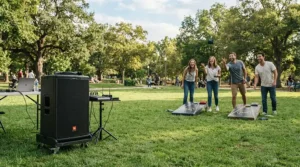
Sony built the ULT Tower 9 around endurance and spectacle. It offers up to 25 hours of battery, 10 minutes of quick charge for up to three hours of playtime, a large woofer, two mid-woofers, and four tweeters. Add Party Connect for linking up to 100 speakers, 360° sound and lighting, karaoke and guitar inputs, a built-in handle with larger wheels, and about 65 pounds of weight.
Sony’s published materials don’t give an RMS figure, so I can’t compare its wattage directly. Judge it by its driver array and the 25-hour runtime instead. The top panel is splash-resistant, but the unit isn’t rated waterproof, so rain isn’t its friend. Best Buy’s page summarizes customers as praising sound quality, battery life, portability, strong bass, and reliable connectivity.
It suits the host who runs from afternoon barbecue to midnight dance floor without hunting for a charger. Its AC-only sibling, the Tower 9AC, runs about $150 cheaper.
Pros:
- ✅ Up to 25 hours of playtime
- ✅ Karaoke, guitar input, and light show built in
- ✅ Party Connect links up to 100 speakers
Cons:
- ❌ RMS wattage isn’t published
- ❌ Only the top panel is splash-resistant
Price: around the $850-$900 range at launch. Verdict: premium, but justified for marathon events.
7. JBL PartyBox 720 — 800W RMS for the biggest yards
This is JBL’s largest battery-capable box: 800W RMS, two 9-inch woofers, two 1.25-inch tweeters, a 32 Hz to 20 kHz response, two swappable JBL Battery 600 packs, and up to 15 hours of playtime. It weighs about 68 pounds, and some bundles ship without batteries.
That low-end reach (32 Hz) is what separates it from the rest. You feel the bass in your chest rather than hear it. SoundGuys’ week-long test of the PartyBox 720, on a unit supplied by the company, called it rollable thanks to the handle and wheels but still a handful at 68 pounds. One retailer-hosted review set averaged about 3.7 stars, and a buyer noted the wheels help tremendously. Another listing review observed it plays louder on AC than on battery, which matches how big amplifiers work.
Pick the JBL PartyBox 720 for a wide lawn, a crowd of fifty, or an annual blowout. For a small yard, it’s overkill.
Pros:
- ✅ 800W RMS with dual 9-inch woofers
- ✅ Two swappable battery packs
- ✅ Deep bass down to 32 Hz
Cons:
- ❌ At 68 lbs, ramps and steps become a two-person job
- ❌ Louder on AC power than on battery
Price: around the $1,000-$1,200 range. Verdict: top-tier output, so check current price.
| Product | Price Range | Review Signal | Best For |
|---|---|---|---|
| Monster Rockin’ Roller 360 | $250-$300 | About 4.5 stars, ~486 reviews (Walmart) | Casual hosts, small yards |
| PRORECK Party 12 | $250-$300 | About 4.7 stars, 34 ratings (Walmart) | Value seekers with an outlet |
| JBL PartyBox Stage 320 | $450-$600 (ballpark) | About 4.1 stars, 1,600+ reviews (aggregator) | Easy-moving all-rounders |
| JBL PartyBox 330 | $600-$650 | Not verified | Flat lawns, frequent movers |
| JBL PartyBox 520 | $800-$900 (ballpark) | Not verified | Larger yards, bigger guest lists |
| Sony ULT Tower 9 | $850-$900 | Praised for sound and battery (Best Buy page) | All-night events and karaoke |
| JBL PartyBox 720 | $1,000-$1,200 | About 3.7 stars (PC Richard) | The biggest crowds |
Read the table as a price-to-effort curve. Between roughly $250 and $650 you buy convenience and a decent output, and above $800 you’re buying volume, battery endurance, or both. The JBL PartyBox 520 and Sony ULT Tower 9 cost more than double the budget pair, but they also hold their output at the volumes where cheaper boxes start to strain. If your yard is small, stopping at the JBL PartyBox Stage 320 saves you real money. Ratings come from different retailers with different sample sizes, so treat them as direction, not verdict.
How to Choose a Large Party Speaker With Wheels for Backyard Use
Choosing well comes down to six decisions. Run through them in order and the field narrows fast.
- Start with your yard, not the watt number. A 20-person patio and a 60-person lawn need very different output. For smaller spaces, 200 to 300W RMS is plenty, while bigger yards deserve 400W RMS or more.
- Compare power on RMS only. Peak figures are marketing flourishes, and mixing the two makes every comparison meaningless.
- Weigh the weight honestly. One buying guide suggests that between 20 and 40 pounds, wheels and a telescopic handle are the sweet spot. Above that, you want a flat route from storage to patio.
- Inspect the handle and wheels. A locking trolley handle, a handle tall enough that you aren’t stooping, and wide wheels matter more than lighting effects.
- Decide on battery versus mains. A swappable pack frees you from outlets, while an AC-only box saves money and weight.
- Check weather protection. IPX4 means splash-resistant, not waterproof. Plan to bring the speaker in before rain.
If you’re torn between two models, pick the lighter one. A speaker you can move easily is a speaker you’ll actually use.
RMS Wattage Explained: The Spec Most Buyers Misread
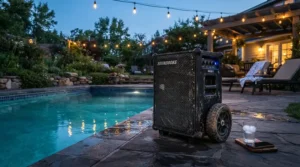
RMS wattage is the continuous power a speaker can sustain, and it is the number that predicts how it behaves after the second hour of the party. Peak power is the brief burst it can survive for a split second. One electronics-engineering explainer gives a handy example: a speaker rated 100W peak but only 40W RMS will run out of clean headroom quickly, while one rated 100W peak and 80W RMS stays clean and sounds fuller.
A pro-audio retailer adds a useful rule of thumb: continuous ratings often land around 25 to 50 percent of peak. That’s why the PRORECK listing mess matters. The same speaker appears as 1000W peak and 1800W peak, yet its reported 150W RMS stays put. RMS wattage is stable, while the peak number floats with the marketing department’s mood.
This also explains the Monster Rockin’ Roller 360. Its 240W figure might be peak, which would put its real output well below the JBL PartyBox Stage 320‘s 240W RMS. Same digits, very different loudness.
When you shop, ask one question: is this RMS? If a listing won’t say, assume it isn’t. JBL states RMS wattage on all four of its models here, which makes them easy to compare. The Sony ULT Tower 9 publishes none, so judge it by drivers and reviews.
High Power Outdoor Party Speaker for Yard: How Much Do You Really Need?
Outdoors, sound escapes in every direction with no walls to bounce it back, so a high power outdoor party speaker for yard use needs more headroom than the same speaker inside. As a rough, analytical rule: 200 to 300W RMS covers a typical suburban yard of 20 to 40 guests, 400W RMS gives comfortable margin for larger lawns, and 800W RMS is for crowds that truly spread out.
More power isn’t automatically better, though. It’s also a hearing issue. NIOSH’s recommended exposure limit is 85 A-weighted decibels averaged over eight hours, and every 3 dBA increase halves the safe exposure time. At roughly 85 dBA you’d need to raise your voice to be heard three feet away. That’s a workplace guideline, but it’s a handy yardstick for a party speaker too.
Practical takeaways: aim the speaker at the guests rather than at your neighbor’s fence, keep the volume where conversation is still possible near the seating area, and put the speaker on a stable surface. Headroom is about clean sound at moderate volume, not about running flat out.
For most yards, the JBL PartyBox Stage 320 or JBL PartyBox 330 is already a high power outdoor party speaker for yard use, and spending more only pays off for larger lawns.
All-Terrain Wheels and the Trolley Handle: What Actually Rolls Over Grass
Marketing loves the phrase all-terrain wheels, so let’s decode it.
All-Terrain Wheels: What “Wide and Sturdy” Buys You
True all-terrain wheels share three traits: a wide contact surface so the speaker doesn’t sink into soft lawn, a bigger diameter that climbs over bumps instead of stopping at them, and enough rubber or tread to keep rolling on gravel. The Monster Rockin’ Roller 360 leans on oversized 5-inch wheels, while JBL’s newer models use what it calls wide, sturdy wheels. JBL claims its JBL PartyBox 330 copes with grass and sand, though a reviewer cautions that uneven terrain gets harder at near 40 pounds.
My honest take: on a mowed lawn, any of these will work. On soft sand, loose gravel, or wet mud, expect a fight.
The Trolley Handle: Locking, Height, and Grip
A good trolley handle does three things: it locks when extended, it sits high enough that you aren’t hunched, and it tilts the speaker onto its wheels without whacking your ankles. The JBL PartyBox 330 advertises a locking version. Reviewers also rate the Monster Rockin’ Roller 360‘s handle highly for sturdiness.
Check the handle’s travel when you shop. A short trolley handle on a tall, heavy speaker forces you to pull at an awkward angle, and that strain adds up over a long carry.
Rolling Party Speaker With Telescoping Handle vs. Handheld Alternatives
Is a rolling party speaker with telescoping handle really better than a lighter, handle-carry battery speaker? It depends on how far you move it and how loud you need it.
| Factor | Wheeled Party Speaker (e.g., JBL PartyBox 330) | Handle-Carry Battery Speaker (e.g., Soundboks Go) | Plug-In PA Combo (e.g., PRORECK Party 12) |
|---|---|---|---|
| Portability | Rolls, but 35-70 lbs | About 20 lbs, one handle | About 60 lbs, wheels on one speaker |
| Output | 280W RMS (330) | 144W RMS | 150W RMS reported |
| Power | Battery, swappable | 40-hour swappable battery | AC only |
| Best For | Yards, flat paths | Camping, carrying over rough ground | Outlet-adjacent lawns, vocals |
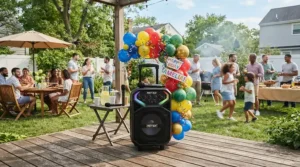
The numbers tell a nuanced story. The Soundboks Go is a compact option rated at 144W RMS and up to 121 dB, with an IP65 rating and a 40-hour swappable battery. It has a single handle and no wheels, so you carry it. The JBL PartyBox 330 doubles the wattage, but you’d never want to carry it far.
The verdict? If you’re hauling across a lawn and up patio steps once, carry the lighter box. If you’re setting up for hours, moving it between yard and garage, and want serious output, wheels win.
Long-Term Cost and Battery Care
A speaker’s price tag is only part of what it costs you. Add a spare battery if the model supports it, a carry or cover solution, and the replacement cycle for a lithium pack that fades with age. Sony itself notes that battery capacity decreases with time and usage.
Care matters more than most buyers realize. Fire-safety agencies consistently advise buying certified products, keeping lithium-ion packs away from heat and anything flammable, and recycling rather than binning old batteries. The U.S. Fire Administration’s battery safety guidance is a good starting point. Practically, that means no leaving the speaker in a hot car or in direct sun, and stopping use if the battery smells odd, swells, or runs hot.
On total cost of ownership, the picture is simple. The PRORECK Party 12 is cheapest upfront but demands an outlet. The JBL PartyBox Stage 320 offers the lowest cost-per-hour among the swappable-battery options. The JBL PartyBox 720 is a long-haul investment, so spread its price across years of events and it looks better.
Real-World Scenarios: Which Speaker Fits Your Backyard?
The weekend barbecue host. You have a small patio, about 20 guests, and a flat path from the garage. A JBL PartyBox Stage 320 gives you enough output and an easy roll without storage headaches.
The graduation-party planner. Fifty guests, a wide lawn, and a DJ-style playlist. The JBL PartyBox 720 earns its weight here, and its dual batteries mean you can run all afternoon without hunting for an outlet.
The karaoke family. Mic-heavy evenings, kids singing off-key, and a long night. The Sony ULT Tower 9 pairs karaoke inputs with 25-hour endurance and a built-in light show, so nobody notices the clock.
The budget-conscious host. A PRORECK Party 12 gets you two speakers, stands, and a mic for the cost of one mid-range box, provided there’s an outlet near the party.
The frequent mover. If you shuttle between a yard and a neighbor’s house, the JBL PartyBox 330 is the easiest to wrangle at 37.7 pounds with a locking trolley handle.
✨ Don’t Miss These Exclusive Deals!
🔍 Take your backyard parties to the next level with these carefully selected speakers. Click on any highlighted product name to check current pricing and availability. These rolling powerhouses will help you create the soundtrack your friends and family will remember!
Setup and Maintenance Guide: Your First 30 Days
Day one: charge and test. Fully charge the battery before the first party and test every input, including Bluetooth, mic, and aux, in the garage. Update the companion app if one exists.
Week one: plan your route. Walk your path from storage to the party spot. Note steps, thresholds, and soft ground. Lay a plywood strip or rubber mat across any lip that stalls the wheels.
Positioning tip. Raise the speaker slightly on a sturdy table or crate if you can, aim it toward guests, and keep it away from the corner of a wall, which can turn bass boomy.
Weather habits. Remember that IPX4 means splash-resistant. Bring the speaker under cover before rain and wipe it down afterward. Sony’s top-panel protection doesn’t cover the whole cabinet.
Battery routine. Store the speaker out of direct sun and heat, recharge after each use, and don’t leave it fully drained for weeks. If your model has a swappable pack, rotate packs to keep wear even.
Common first-month mistakes. Running the volume flat out all night, dragging the speaker with the handle collapsed, forgetting to lock the handle, and leaving it outside overnight. Fix those four and you’ll preserve both the sound and the wheels.
Problem → Solution Guide for Backyard Party Speakers
Problem: the speaker sinks into the lawn. Solution: roll it on a path of pavers or place a plywood sheet under the wheels, and pick a model with wide wheels like the JBL PartyBox Stage 320.
Problem: bass sounds muddy. Solution: move the speaker away from walls and corners, lower the bass setting in the app, and avoid placing it directly on a metal table that rattles.
Problem: it’s too heavy to move alone. Solution: choose the lighter model next time, or use a two-person approach on steps. Reviewers note even the wheeled PRORECK Party 12 is hard to manage solo.
Problem: the battery dies mid-party. Solution: buy a spare pack for models with swappable batteries, such as the JBL PartyBox 520, or plug in and keep the battery as backup.
Problem: voices disappear in the mix. Solution: use a dedicated mic input with the volume trimmed below the music, and consider the PRORECK Party 12‘s horn-style driver for clarity.
FAQ: Large Party Speaker With Wheels for Backyard
❓ How many watts RMS do I need for a backyard party?
❓ Can I leave a wheeled party speaker outside in the rain?
❓ Will a heavy party speaker roll on grass?
❓ Is a spare battery worth buying?
❓ Can I link two party speakers together?
Conclusion: Roll Into the Season With the Right Speaker
The best large party speaker with wheels for backyard parties isn’t the loudest one on the shelf. It’s the one that matches your yard, your guest list, and your tolerance for hauling. Small lawn and easy path? The JBL PartyBox Stage 320 or JBL PartyBox 330 wins. Bigger crowds? The JBL PartyBox 520 is the sweet spot, and the JBL PartyBox 720 is for blowouts. Budget-first with an outlet nearby? Look at the PRORECK Party 12. Marathon karaoke nights belong to the Sony ULT Tower 9.
Whatever you pick, anchor your choice on RMS wattage, inspect the trolley handle and the wheels, and treat any peak figure with suspicion. Then enjoy the part that matters: pulling up the handle, tilting the box, and rolling the party out to the lawn.
✨ Ready to Roll the Party Out?
🔍 Compare the models above, check current pricing and availability, and pick the one that fits your yard. Your next backyard party deserves a soundtrack that travels with you!
Recommended for You
- Swappable Battery Party Speaker for All-Day Events: 7 Best Picks 2026
- Tailgate Party Speaker With Deep Bass: 7 Epic Picks (2026)
- Party Speaker With Microphone and Guitar Input: 7 Best Picks 2026
Disclaimer: This article contains affiliate links. As an Amazon Associate, I earn from qualifying purchases. If you purchase products through these links, we may earn a small commission at no additional cost to you.
✨ Found this helpful? Share it with your friends! 💬🤗
