
In This Article
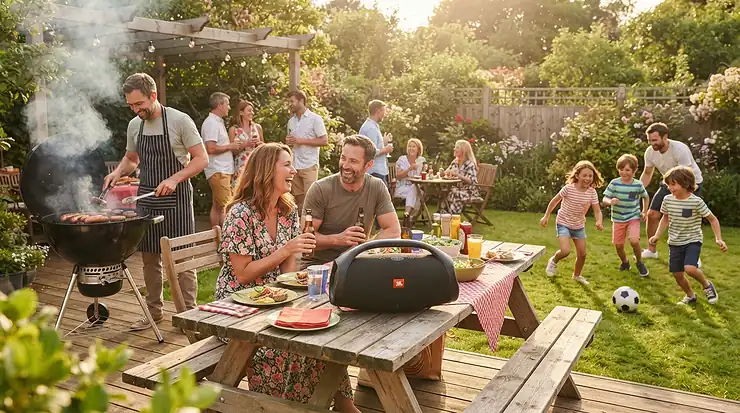
Picture hour six of a backyard birthday. The cake is a memory, the cousins have discovered the bass button, and your speaker’s battery light just went red. A swappable battery party speaker for all-day events turns that moment into a ten-second chore. Slide out the tired pack, slide in a charged one, carry on. No extension-cord marathon. No frantic hunt for the only outlet behind the hedge.

That’s the promise. The fine print is where it gets interesting. Plenty of speakers shout “long battery life” on the box, yet only a handful let you change the pack yourself. And the headline hours are usually measured at volumes far politer than a real dance floor. So this guide does three jobs. It separates genuinely swappable models from sealed ones, translates spec-sheet numbers into hours you can plan around, and ranks seven real options, from a strap-carry 100W box to a wheeled 400W giant.
Everything here rests on manufacturer specs, retailer listings and published tests, including independent party-speaker testing at RTINGS. Where a model’s real-world reviews couldn’t be verified, the article says so rather than guessing. Prices appear as ranges only and shift often, so check current price before you buy.
What Is a Swappable Battery Party Speaker for All-Day Events?
A swappable battery party speaker for all-day events is a portable, high-output speaker whose rechargeable battery pack slides out and can be replaced with a charged spare in seconds. Instead of waiting hours for a recharge, you extend runtime by carrying extra packs. That suits tailgates, campsites and long outdoor gatherings without power. Think of a camera with spare batteries, only louder.
Quick Comparison: Which Swappable Battery Party Speaker Fits Your Event?
Rated runtimes below are per pack, under each manufacturer’s test conditions. Real party volume will land lower, which is why the spare matters so much.
| Speaker | Rated Runtime (per pack) | Swappable Pack | Best For |
|---|---|---|---|
| JBL PartyBox Stage 320 | Up to 18 hrs | Battery 400 (68Wh) | Big outdoor crowds |
| JBL PartyBox Club 120 | Up to 12 hrs | Battery 200 (34Wh) | Backyard parties |
| JBL PartyBox 520 | Up to 15 hrs | Battery 600 (99.02Wh) | Large events, mic and guitar |
| JBL Xtreme 4 | Up to 24 hrs (+6 with Playtime Boost) | Battery 400 (68Wh) | Camping, beach, pool |
| JBL PartyBox Encore Essential 2 | Up to 15 hrs | Battery 200-compatible (34Wh) | Small groups on a budget |
| JBL PartyBox On-the-Go 2 | Up to 15 hrs | Battery 200-compatible (34Wh) | Strap-carry portability |
| Bose S1 Pro+ | Up to 11 hrs | Bose S1 Pro+ battery pack | Speeches, live acoustic sets |
Looking at the comparison above, the JBL Xtreme 4 posts the longest runtime per pack. The JBL PartyBox Stage 320 is the sweet spot if you need real volume with a spare that doubles your hours. Budget hosts should note that the JBL PartyBox Club 120, JBL PartyBox Encore Essential 2 and JBL PartyBox On-the-Go 2 can all use the same Battery 200 pack, which keeps spares cheap and flexible. The Bose S1 Pro+ has the shortest runtime, but that trades hours for speech clarity rather than signalling a flaw.
💬 Just one click — help others make better buying decisions too!😊
Top 7 Picks for a Swappable Battery Party Speaker for All-Day Events
1. JBL PartyBox Stage 320 — wheels, handle and a 36-hour ceiling
The JBL PartyBox Stage 320 is the pick when “all-day” really means all day. A telescopic handle and wheels let one person roll serious sound across grass, while a rear slot accepts a second battery.
Two 6.5-inch woofers and 240W of output sit in a 36-lb (16.5 kg) IPX4 cabinet. The Battery 400 pack (68Wh) is rated at up to 18 hours, but SoundGuys notes that figure assumes 50% volume with bass boost and lights off. Translation: the spec describes a calm brunch, not a bass-boosted dance floor. A spare lifts the theoretical ceiling to 36 hours, and a 10-minute fast charge adds roughly two hours. A USB-A port can charge a phone or play a thumb drive.
Based on the spec comparison, this suits big yards, tailgates and park gatherings, where outlets are scarce and carrying 36 lb gets old quickly. It also shares its pack with the JBL Xtreme 4, so owning both lets you trade spares. Published feedback is broadly positive. SoundGuys scored it 8.2, praising the improved mobility and swappable packs while dinging the missing XLR and USB-C inputs.
Pros:
- ✅ 240W output fills large outdoor areas
- ✅ Wheels and telescopic handle ease transport
- ✅ Spare pack doubles rated runtime to 36 hours
Cons:
- ❌ No XLR input for pro mixers
- ❌ Heavy at 36 lb on stairs
Expect around the $550–$650 range; check current price. For regular outdoor hosts, the doubled runtime and wheels justify the premium over the Club 120.
2. JBL PartyBox Club 120 — the lighter, cheaper sibling with the same swap trick
The JBL PartyBox Club 120 delivers the swap-a-pack idea in a 24-lb (11 kg) box with a flip-up handle, which is much friendlier to carry than its big brother.
It produces 160W through two 5.25-inch woofers and carries an IPX4 rating. JBL rates the Battery 200 pack (34Wh) at up to 12 hours, but SoundGuys points out that number assumes just 25% volume with bass boost and lights off. That is background-music territory, so a spare is less a luxury than a necessity at louder settings. A 10-minute fast charge buys about 80 minutes. The app adds a customizable 5-band EQ.
The Battery 200 is the cheapest spare in this lineup, and it fits several other JBL models, which makes this a sensible starter ecosystem. SoundGuys suggests it handles most backyards short of “tennis-court” size. Reviewers flag the lack of wheels and a grille that dents easily. One retailer reviewer also reported a spare lasting only about two hours at low volume. That’s a single data point, but it’s a reason to check pack health in the app.
Pros:
- ✅ Lighter and easier to carry than the Stage 320
- ✅ Inexpensive spare pack at roughly $75–$85
- ✅ Two mic or guitar inputs plus a customizable EQ
Cons:
- ❌ No wheels for long hauls
- ❌ Grille dents easily
Expect around the $350–$420 range; check current price. It’s strong value for backyard hosts who want swappable power without paying for 240W.
3. JBL PartyBox 520 — 400W for crowds that don’t whisper
The JBL PartyBox 520 is the heavyweight here. It’s built for gatherings where “can everyone hear that in the back?” is a real question.
Output is 400W RMS through dual 7.5-inch woofers and dual 1-inch tweeters. Weight is 56.2 lb (25.5 kg), so the wheels and telescopic handle are survival gear. The Battery 600 pack is 99.02Wh, rated at up to 15 hours with a 10-minute fast charge adding about two hours. Output includes a USB-C port rated at 30W per one retailer spec sheet. A twin pack of Battery 600 stretches the family’s total playback considerably, per retailer listings.
On paper this is the strongest option for weddings, community events and bands that need mic and guitar inputs. SoundGuys also notes it adds XLR/TRS combo jacks and USB-C audio, which the 320 lacks. One review praised its sound quality as among the best in the category while wishing the battery lasted longer. That’s a fair criticism at 400W. The pack’s size also matters when flying, covered in the safety section below.
Pros:
- ✅ 400W RMS for genuinely large crowds
- ✅ XLR/TRS combo inputs and USB-C audio
- ✅ USB-C power-out at 30W per retailer specs
Cons:
- ❌ 56 lb is a real two-person lift
- ❌ Highest price in the JBL lineup
Expect around the $800–$900 range; check current price. It’s only worth it if you truly need that volume and input flexibility.
4. JBL Xtreme 4 — 24 hours per pack and IP67 toughness
The JBL Xtreme 4 trades PA-style bulk for endurance. It’s the long battery life party speaker for outdoor events that you can toss in a beach bag, give or take a strap.
Retailer listings put the 68Wh pack at up to 24 hours, with Playtime Boost adding up to six more by tuning for efficiency. A 10-minute charge adds about two hours. It carries an IP67 rating, meaning dust-tight and survivable in shallow water. One retailer lists 100W RMS on AC and 70W on battery. A built-in USB-C power bank is rated at up to 22W Power Delivery, so a dying phone doesn’t have to compete with the playlist. The Battery 400 spare is shared with the Stage 320.
This is the pick for campsites, pool decks and beach days where splashes and sand matter more than raw SPL. I couldn’t find independent consumer-review text I could verify for this model, so treat marketing claims as manufacturer-reported until more tester data appears.
Pros:
- ✅ Longest rated runtime per pack in this list
- ✅ IP67 handles sand, spray and shallow water
- ✅ Built-in USB-C power bank at 22W
Cons:
- ❌ Less output than the PartyBox models
- ❌ Independent real-world data still thin
Budget roughly the $300–$450 band as a planning figure, since prices varied across listings; check current price. For wet, wandering events, the weatherproofing is the real value.
5. JBL PartyBox Encore Essential 2 — the budget door into swappable power
The JBL PartyBox Encore Essential 2 is the entry-level answer for people who want a party speaker with replaceable battery pack flexibility without wheels or a wallet-eating price.
It delivers 100W, weighs about 13.2 lb (6.2 kg), and is IPX4 splash-proof. Its 34Wh pack is rated at up to 15 hours and charges in under 3.5 hours. Listings show a mic/guitar input and a USB-C power-bank output rated at 22W. JBL’s compatibility notes also list it among the speakers that accept the Battery 200 spare. Its mic-bundled sibling, the Encore 2, shares the platform.
Analysis: this is ideal for small groups, kids’ parties and patios of modest size. A 34Wh pack is small, so loud use shortens runtime, and sharing a pack with the Club 120 and On-the-Go 2 is a genuine ecosystem perk. Retailer reviewers praise the bass and say it stays clean when pushed, with battery impressions mostly solid. One reviewer put real play time near six hours, which is plausible at high volume.
Pros:
- ✅ Affordable entry into swappable packs
- ✅ Light enough to carry one-handed
- ✅ 22W USB-C power-bank output
Cons:
- ❌ 100W struggles with large crowds
- ❌ Small pack drains fast at loud volumes
Expect around the $250–$400 range depending on promotions; check current price. It’s strong value for modest gatherings.
6. JBL PartyBox On-the-Go 2 — strap-carry party sound with a 15-hour pack
The JBL PartyBox On-the-Go 2 is the speaker you sling over a shoulder and walk to the party. It’s compact, strapped and still swappable.
JBL lists 100W RMS, a 5.25-inch woofer with two dome tweeters, and a 34Wh pack rated at up to 15 hours. It weighs about 6.36 kg (roughly 14 lb) and is IPX4-rated. Bluetooth is 5.4. USB charge-out is rated 11V/2A maximum, but only in speaker-off mode, so it won’t charge your phone mid-song. Some retailer listings call the swap “hot-swappable” and mention a 10-minute charge giving 80 minutes, though JBL’s own wording simply says to swap in a spare.
The standout is portability. It makes the most sense for beach walks, picnics and small events where a wheeled box would be overkill. Because it launched recently, the verified review pool is small. One retailer reviewer praised portability for the size and said the battery keeps the music going, but that’s a single voice. Some bundles include wireless mics for karaoke.
Pros:
- ✅ Shoulder strap makes it highly portable
- ✅ Shares the affordable Battery 200 spare
- ✅ Bluetooth 5.4 and 15-hour rating
Cons:
- ❌ Power-bank output works only when off
- ❌ Limited verified review data so far
Expect roughly $250–$350, though pricing varied; check current price. It’s good value if the strap is the feature you’d actually use.
7. Bose S1 Pro+ — PA-grade clarity with a swappable 11-hour pack
The Bose S1 Pro+ is the odd one out, and that’s why it’s here. It’s a battery-powered PA system rather than a bass cannon, built for voices and acoustic music.
Bose rates its lithium-ion pack at up to 11 hours at high output levels, with a roughly four-hour recharge. The pack installs in a dedicated compartment and charges while inside. It also includes a three-channel mixer for mics and instruments. Bose’s materials say you can add an extra pack or replace the original, but they don’t describe a gapless swap, so plan on a short pause.
The practical meaning is simple. For wedding toasts, school events and live acoustic sets, you get clear speech from a speaker that’s easy to move. A spare pack costs roughly $150–$200 in listings I found, which is the highest per-hour cost here. Buyer comments on one retailer’s page describe the swap as easy, and one said their original pack stopped holding a charge after a move. A useful reminder that packs age.
Pros:
- ✅ Speech and acoustic clarity are the focus
- ✅ Built-in three-channel mixer
- ✅ Spare pack stores inside the cabinet
Cons:
- ❌ Shortest runtime of the seven
- ❌ Pricey spare pack at roughly $150–$200
Priced in the premium tier, well above the Club 120; check current price. It’s worth it for speech-heavy events, not for pure bass.
Top 7 at a Glance: Specs and Price Ranges
| Speaker | Output | Water Rating | Spare Pack (approx. cost) | Price Range | Best For |
|---|---|---|---|---|---|
| JBL PartyBox Stage 320 | 240W | IPX4 | Battery 400 ($110–$120) | $550–$650 | Large outdoor events |
| JBL PartyBox Club 120 | 160W | IPX4 | Battery 200 ($75–$85) | $350–$420 | Backyard parties |
| JBL PartyBox 520 | 400W RMS | IPX4 | Battery 600 (premium; check price) | $800–$900 | Big crowds, bands |
| JBL Xtreme 4 | 100W RMS (AC) | IP67 | Battery 400 ($110–$120) | Check current price | Camping, beach |
| JBL PartyBox Encore Essential 2 | 100W | IPX4 | Battery 200 ($75–$85) | $250–$400 | Small groups |
| JBL PartyBox On-the-Go 2 | 100W RMS | IPX4 | Battery 200 ($75–$85) | $250–$350 | Strap-carry use |
| Bose S1 Pro+ | PA-style, 3-ch mixer | No IP rating listed | Bose pack ($150–$200) | Premium; check price | Speeches, acoustic sets |
The table shows that the JBL PartyBox Club 120 and JBL PartyBox Stage 320 offer the best balance of volume and spare-pack economics. Hosts needing waterproofing should favor the JBL Xtreme 4, while speech-focused events point to the Bose S1 Pro+ despite its higher cost per added hour.
Hot Swap Battery Playbook: Keeping the Music Alive Without a Gap
A hot swap battery change means replacing the power source while the event is still running. Here’s the catch. JBL says you can pop a fresh pack into the slot in seconds, and some retailers call the design hot-swappable, but none of the sources reviewed promise gapless audio. Treat the swap as a short pause unless you’ve tested your own unit.
A simple routine keeps it smooth:
- Charge both packs the night before. Pack A goes in, Pack B stays on the table.
- Label them. A strip of tape saves arguments about which one is fresh.
- Swap at 15–20%, not zero. The JBL PartyBox app reports battery state of health on supported models.
- Plug in first if you can. SoundGuys confirms the JBL PartyBox Stage 320 and JBL PartyBox Club 120 run on AC while charging, so the music never stops.
- Recharge the spent pack immediately. One retailer lists about three hours for a Battery 200 using a charging case and 60W adapter.
- Keep spares cool. JBL lists 0–45°C as the operating range.
Common first-30-day mistakes include mixing pack models (Battery 200, 400 and 600 are not interchangeable) and leaving packs in a hot car. The fix for both is a labeled, shaded gear bag.

Playtime Per Charge: What the Numbers Really Mean
Playtime per charge is the most flattering number on any spec sheet, so it pays to read the test conditions.
- JBL PartyBox Club 120: 12 hours at 25% volume, bass boost and lights off (SoundGuys).
- JBL PartyBox Stage 320: 18 hours at 50% volume, bass boost and lights off (SoundGuys).
- Sony ULT Field 7: 30 hours at roughly 25% volume with lights and ULT modes off. Tom’s Guide notes that enabling them can drop runtime to about 7 hours.
- Ultimate Ears Hyperboom: 24 hours at around half volume (Expert Reviews).
Runtime is simply watt-hours divided by average power draw. A mellow playlist and a bass-boosted dance floor can differ by a factor of several. As a planning habit, rather than a measured law, budget about half the rated hours for loud, lit-up use. A 12-hour rating becomes six hours of real party. That’s exactly why a spare pack, not the headline number, decides whether you cover an all-day event.
How to Choose a Swappable Battery Party Speaker for All-Day Events
- Start with hours, not watts. Count the real event length, then halve each rated runtime for loud use.
- Check the pack size in Wh. A 34Wh pack and a 99Wh pack are different animals, even at the same “15 hours.”
- Confirm the spare exists and is in stock. Battery 200, 400 and 600 each fit specific models only.
- Match the water rating to the setting. IPX4 handles splashes, IP67 handles sand and shallow water.
- Weigh the carry. Anything near 36 lb needs wheels, and 56 lb needs a plan.
- Plan your phone. Check the power-bank output and whether it works while playing.
- Budget the spare up front. The pack is part of the purchase, not an afterthought.
✨ Don’t Miss These Exclusive Deals!
🔍 Take your all-day outdoor sound to the next level with these carefully selected speakers. Click on any highlighted item to check current pricing and availability. These picks will help you create unforgettable gatherings your guests will love!
Power Bank Output: Turning Your Speaker Into a Phone Lifeline
Power bank output is the unglamorous feature that rescues parties. At hour eight, your phone, which is also your playlist, is usually the weak link.
The JBL PartyBox 520 lists a 30W USB-C output, while the JBL Xtreme 4 and JBL PartyBox Encore Essential 2 list 22W. The JBL PartyBox On-the-Go 2 is rated 11V/2A maximum, but only in speaker-off mode. The JBL PartyBox Stage 320 and JBL PartyBox Club 120 offer a USB-A port, and I found no wattage figure for either. One retailer lists a Battery 200 charging case with a 30W USB-C output.
The catch is simple physics. A phone charge can take a meaningful share of a small pack. As a rough estimate, a full charge might use a third to half of a 34Wh battery, versus a fifth or less of the 99Wh pack in the JBL PartyBox 520. Charge phones from the speaker early and briefly, or keep a separate phone power bank. For speech-focused setups, the Bose S1 Pro+ lists no power-bank function in the sources I reviewed.
Party Speaker with Replaceable Battery Pack vs Sealed-Battery Speakers
A party speaker with replaceable battery pack is a different promise from a sealed-battery speaker that simply claims huge hours. The sealed ones can be excellent, and some outlast the swappable models on a single charge. But when they run out, they run out.
| Feature | Replaceable Pack (e.g., JBL PartyBox Stage 320) | Sealed Battery (e.g., Sony ULT Field 7, Ultimate Ears Hyperboom) |
|---|---|---|
| Extending runtime mid-event | Swap in a charged spare | Plug in and wait |
| Rated runtime example | 18 hrs per pack, 36 with spare | 30 hrs (Field 7), 24 hrs (Hyperboom) |
| When the battery ages | Replace the pack | Replace the whole speaker or pay for repair |
| Upfront cost | Speaker plus spare | Speaker only |
| Best For | Events longer than one charge | Single-charge days with a nearby outlet |
Tom’s Guide rates the Sony ULT Field 7 at 30 hours but notes the figure assumes low volume with lights and ULT modes off. Enabling them can cut runtime to about seven hours. The Ultimate Ears Hyperboom carries a 24-hour rating at around half volume and a built-in power bank, according to Expert Reviews.
Based on the comparison, sealed speakers win on simplicity and sometimes on single-charge hours. Swappable ones win the moment an event outlasts one charge, or when you want the speaker to survive a worn-out battery. For anyone hosting regularly, that second point matters more than it sounds.
Long Battery Life Party Speaker for Outdoor Events: Heat, Sun and Splash
A long battery life party speaker for outdoor events faces three enemies: sun, spills and distance from power. Each one affects which model makes sense.
Start with the weather rating. IPX4 on the JBL PartyBox Stage 320, JBL PartyBox Club 120, JBL PartyBox 520, JBL PartyBox Encore Essential 2 and JBL PartyBox On-the-Go 2 means splashes are fine but submersion is not. The JBL Xtreme 4‘s IP67 rating suits sand, pool decks and hose-downs.
Heat matters too. JBL lists a 0–45°C operating range for its Battery 200 and Battery 400, so a spare baking in a parked car is a real risk. Keep packs shaded and cool, and store the speaker out of direct sun when you can, since black enclosures soak up heat.
Coverage is the third factor. JBL says the JBL PartyBox Stage 320 can fill a tennis-court-sized outdoor area. Smaller models will do fine for patios but need to be pushed harder, and pushing harder drains the pack. Size the speaker to the space and you’ll gain hours without buying anything extra.

Real-World Scenarios: Matching a Speaker to Your Event
Scenario 1: The tailgate host. Ten hours in a stadium lot, no outlet, 40 guests, moderate volume. The JBL PartyBox Stage 320 with a spare Battery 400 gives a theoretical 36 hours and wheels for the walk. Budget: around $550–$650 plus about $110–$120 for the spare. Frequency: every home game, so the investment pays off.
Scenario 2: The weekend camper. Two days at a lakeside site, splashes, sand and a small group. The JBL Xtreme 4 brings 24 hours per pack and IP67 toughness, and a spare Battery 400 stretches that to a weekend. This is the case where a long battery life party speaker for outdoor events beats a wheeled box.
Scenario 3: The budget backyard birthday. Eight hours, 20 guests, one outlet on the far side of the yard. The JBL PartyBox Club 120 or JBL PartyBox Encore Essential 2, plus an inexpensive Battery 200, covers the day. Budget: roughly $250–$420 plus about $75–$85.
Scenario 4: The wedding toast and acoustic set. Speech clarity matters more than bass. The Bose S1 Pro+, with a spare pack stored inside the cabinet, fits the job. Budget: premium, plus roughly $150–$200 for the spare.
Long-Term Cost & Maintenance
The real cost of a swappable battery party speaker for all-day events is the speaker plus the spare. At list-price midpoints, treat these as rough estimates. A Battery 200 at about $80 adds up to 12 rated hours, or roughly $6–7 per added hour. A Battery 400 at about $115 adds up to 18 hours, or about $6 per hour. The Bose S1 Pro+ spare at about $175 adds up to 11 hours, or about $16 per hour.
Maintenance is mostly habit. Use the JBL PartyBox app’s state-of-health reading to spot a weakening pack. Avoid storing packs fully drained or in heat. Buy official packs. One buyer on a retailer page said they chose a Bose original because cheap imitations circulate online, and JBL stresses that its official batteries are guaranteed to work with its speakers. The upside of a party speaker with replaceable battery pack is that aging becomes a $75–$200 problem instead of a speaker-replacement problem. For frequent hosts, that is the strongest ROI argument.
Common Mistakes When Buying
Chasing wattage and ignoring hours. A 400W speaker with a 15-hour pack still needs a spare for a 12-hour party at real volume.
Ignoring hearing. The CDC’s NIOSH sets a recommended exposure limit of 85 dBA over eight hours, and allowable time halves for every 3 dB louder. The limit is an occupational guideline, but protecting your ears is sensible at any party. Running volume lower also stretches battery life.
Skipping the spare. The swappable feature is only as good as the second pack. Buy it with the speaker.
Assuming packs are interchangeable. The Battery 200, 400 and 600 each fit specific models.
Forgetting weight. A 56-lb speaker is a two-person job, so a speaker you’ll actually carry beats a spec-sheet winner.
Safety, Flying and Storage for Spare Speaker Batteries
If your event involves a plane, packs fall under airline rules. The FAA’s guidance limits spare lithium-ion batteries to 100Wh each, and they must travel in carry-on baggage only. Spares between 101 and 160Wh need airline approval, with a limit of two per person.
The numbers here are friendly. Battery 200 is 34Wh and Battery 400 is 68Wh, both comfortably under the limit. Battery 600 is rated at 99.02Wh, which is just under 100Wh, so carry the label-side up and confirm with your airline before you travel. At home, store packs in a cool, dry place, away from metal objects that could short the terminals. The airline rules require terminal protection, so tape or a case is wise.
FAQ
❓ Can you swap the battery on a JBL PartyBox without turning it off?
❓ Which swappable-battery party speaker has the longest runtime per pack?
❓ Can I bring spare party speaker batteries on a plane?
❓ Can a swappable battery party speaker charge my phone?
❓ How many spare batteries do I need for a 10-hour party?
Conclusion
A swappable battery party speaker for all-day events isn’t about bragging rights on runtime. It’s about control. You decide when the music stops, not the battery icon.
For most hosts, the JBL PartyBox Stage 320 is the best all-rounder, pairing 240W, wheels and a spare that doubles your hours. If your budget is tighter, the JBL PartyBox Club 120 or JBL PartyBox Encore Essential 2 deliver the same swap-a-pack idea at lower cost. Campers and pool people should look to the JBL Xtreme 4 and its IP67 build, while crowds and bands will want the JBL PartyBox 520. The JBL PartyBox On-the-Go 2 is the carry-anywhere option, and the Bose S1 Pro+ is the choice when voices matter more than bass.
Whatever you pick, buy the spare with the speaker, halve the rated hours for loud use, and respect your ears. Plan for the party you’ll actually throw, not the one the spec sheet imagines.
Recommended for You
- Large Party Speaker With Wheels for Backyard: 7 Epic Picks 2026
- Tailgate Party Speaker With Deep Bass: 7 Epic Picks (2026)
- Party Speaker With Microphone and Guitar Input: 7 Best Picks 2026
Disclaimer: This article contains affiliate links. As an Amazon Associate, I earn from qualifying purchases. If you purchase products through these links, we may earn a small commission at no additional cost to you.
✨ Found this helpful? Share it with your friends! 💬🤗
