In This Article
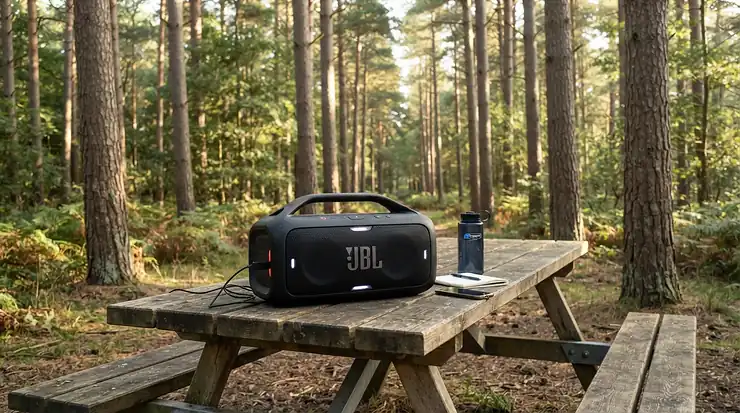
A tailgate party speaker with deep bass is a battery-powered, weather-resistant Bluetooth speaker built to push serious low frequencies outdoors, usually through big woofers, passive radiators or tuned ports. The best ones pair bass boost modes with long battery life and dust and splash resistance, so the beat survives spilled drinks, parking-lot noise and surprise showers.
Here’s the part nobody mentions on the product page. Outdoors, there are no walls to bounce bass back at you. Your living-room speaker gets free low-end reinforcement from the corners. A parking lot gives you asphalt, wind and eight hundred other people’s playlists. Bass in open air is a leaky bucket, and a pocket-sized speaker with a “bass boost” sticker can’t fill it.
That’s why this guide skips the tiny stuff. It covers seven real, current models, from a wheeled 240W monster to a four-pound IP67 brick. Each is judged on spec sheets, published expert reviews and aggregated owner feedback, not marketing swagger. Independent testers like RTINGS keep running party-speaker rankings, and a few of these picks appear there. Expect honest trade-offs, not a love letter to every box.
Next comes a quick comparison table, then seven detailed breakdowns. After that is the useful nerdy stuff: passive radiators, low frequency extension and what those IP ratings really promise. Prices throughout are ranges only and move often, so check current pricing before you buy.
Quick Comparison: 7 Best Picks for a Tailgate Party Speaker With Deep Bass
| Pick | Best For | Dust/Splash Rating | Claimed Battery | Price Range |
|---|---|---|---|---|
| JBL PartyBox Stage 320 | Crowds of 30+ and wheel-it-in convenience | IPX4 | Up to 18 hrs | Mid-$500s to $600 |
| Sony ULT Field 7 | Rain-or-shine reliability and punchy bass modes | IP67 | Up to 30 hrs | $400-$500 |
| Ultimate Ears Hyperboom | Wide, loud sound for long sessions | IPX4 | Up to 24 hrs | $300-$400 |
| Bose SoundLink Max | Polished bass for mixed playlists | IP67 | Up to 20 hrs | $300-$400 |
| Soundcore Boom 2 Plus | Best budget bass | IPX7 | Up to 20 hrs | $180-$250 |
| JBL PartyBox 110 | Small crews and pregame karaoke | IPX4 | Up to 12 hrs | Around $300 |
| JBL Xtreme 4 | Long walks from the far lot | IP67 | Up to 24 hrs | $300-$380 |
Look at the table sideways and a pattern appears. The heavy, wheeled and large-cabinet models (JBL PartyBox Stage 320, JBL PartyBox 110) win on raw output but settle for splash-only protection. The IP67 models (Sony ULT Field 7, Bose SoundLink Max, JBL Xtreme 4) trade some cabinet volume for armor. Soundcore Boom 2 Plus is the outlier, delivering rugged IPX7 protection and dual woofers at a price that makes the premium picks look nervous.
💬 Just one click — help others make better buying decisions too!😊
Top 7 Tailgate Party Speaker With Deep Bass Picks: Expert Analysis
1. JBL PartyBox Stage 320 — wheeled 240W flagship with a swappable battery
Think of it as a rolling bass cabinet that happens to speak Bluetooth. The JBL PartyBox Stage 320 is rated at 240W, lists a low-end response around 40Hz and claims up to 18 hours of playtime. On paper, 40Hz means kick drums and 808s register as pressure in your chest instead of polite suggestions. At roughly 36 pounds it’s no featherweight, but the built-in wheels and telescopic handle turn a two-person lift into a one-person stroll across the lot.
Based on the spec comparison, this is the pick when your tailgate regularly hits 30 people and you want one speaker to carry the whole scene. The removable battery matters more than it sounds, because swapping packs means the party can outlive a single charge. The catch is protection. IPX4 handles splashes from any direction but carries no dust rating, so treat it like a nice patio chair, not a tractor.
Published reviews are warm. SoundGuys rates it 8.2 out of 10 and highlights bass and portability, though its reader-submitted value score runs noticeably lower, which fits the premium price. Retailer feedback skews strongly positive.
Pros:
- ✅ Deep low end, listed near 40Hz
- ✅ Wheels and telescopic handle tame the weight
- ✅ Mic and guitar inputs for pregame karaoke
Cons:
- ❌ IPX4 splash rating only, no dust rating
- ❌ Bulky for small trunks
Expect a mid-$500s to $600 range (check current price). It’s premium, but fair value if your crowd is big enough to need it.

2. Sony ULT Field 7 — IP67 armor with one-button bass modes
The Sony ULT Field 7 is the speaker for people who don’t trust the weather forecast. Its IP67 rating means fully dust-tight and able to survive about a meter of water for 30 minutes. In practice, you can rinse barbecue grease off the grille. Two ULT modes sit under one button: ULT1 chases deeper low-frequency rumble, and ULT2 goes for punchier thump. Sony claims up to 30 hours of battery. Retailer specs put it around 14 pounds, carryable but not pocketable, and it has 3.5mm and 6.3mm inputs for instruments and a mic.
TechRadar praises its impressively deep bass but warns not to expect much fine detail, and RTINGS notes the bass range compresses as you approach maximum volume. Translated for a parking lot, this speaker sounds best around 80 to 85 percent volume with ULT mode doing the heavy lifting, not redlined until the bass turns to mush.
Retail owners commonly describe heavy bass and big volume, with a recurring wish for crisper treble. A few reviewers note battery life shrinks noticeably when lights and loud levels combine.
Pros:
- ✅ IP67 dust-tight, immersion-rated build
- ✅ ULT1 and ULT2 bass modes switch instantly
- ✅ Up to 30 hours claimed battery
Cons:
- ❌ Bass compresses near maximum volume
- ❌ Detail and treble take a back seat
Look for a $400-$500 range at the time of research. It’s strong value if your tailgate has unpredictable weather.
3. Ultimate Ears Hyperboom — twin passive radiators and a 24-hour claim
If the Ultimate Ears Hyperboom were a person, it’d be the big friend who somehow never raises his voice. Behind its woven fabric cover sit two 114mm woofers, two 25mm tweeters and two sizable passive bass radiators. With IPX4 splash resistance and a roughly 13 to 15 pound weight (sources vary), it’s a luggable, not a pocketable.
Here’s where reviews get interesting. One Australian review called it the best bass-centric portable the reviewer had ever tested and measured loudness north of 100dB. Gadget Review’s roundup says its bass isn’t as deep as true bassheads might want. Both can be true. The twin radiators deliver wide, effortless mid-bass thump, but if you’re chasing sub-bass rumble, bigger cabinets go lower. Tom’s Guide reported about half the battery left after roughly 12 hours at varied volumes, which supports the long-session claim.
Aggregated impressions favor its customizable EQ, wide soundstage and sturdy build, while size and weight come up as the main complaints.
Pros:
- ✅ Twin passive radiators move plenty of air
- ✅ Wide, room-filling sound at party volume
- ✅ Long battery life in independent testing
Cons:
- ❌ IPX4 only, so no real dust protection
- ❌ Sub-bass depth trails the biggest cabinets
Expect a $300-$400 range, depending on stock and promotions (check current price). It’s good value for sound spread, less so if sub-bass is your only goal.
4. Bose SoundLink Max — IP67 build with tuned passive radiators
The Bose SoundLink Max looks like a sleek gym bag, but the engineering is serious. It combines a three-driver front array with two custom passive radiators, an IP67 shell against water, dust and corrosion, and a claimed 20 hours of playtime. There’s an aux input too, handy when Bluetooth gets crowded in a packed lot.
What stands out in reviews is the tuning. German testers at testit.de found the factory bass too heavy, then called it tight and energetic after lowering the bass slider several steps. What Hi-Fi suggests a similar notch-or-two trim. That’s useful guidance: the bass here has real weight, and your job is to rein it in, not chase it. SoundGuys scores it 7.4 out of 10 and warns that bass-heavy presets at high volume, especially while charging a phone, cut playtime fastest.
Owners frequently praise the build quality and power, while reviewers note there’s no microphone for calls.
Pros:
- ✅ IP67 protection against dust and immersion
- ✅ Bass depth with a polished, controlled character
- ✅ Handy aux input and phone-charging port
Cons:
- ❌ Factory bass can run overly heavy
- ❌ Battery drops fast at max volume
It sits in a $300-$400 range (check current price). The value is solid for mixed playlists, less so for pure karaoke.
5. Soundcore Boom 2 Plus — dual woofers and BassUp 2.0 on a budget
The Soundcore Boom 2 Plus is the underdog with a chip on its shoulder. It pairs two 4.5-inch woofers and two 1-inch tweeters with two passive radiators and an active crossover. Its 40Hz–40kHz listed response is wide, and it floats thanks to IPX7 protection. The 140W headline figure only applies in BassUp mode. Normal mode is rated at 100W, which is still plenty for a small-to-mid crowd. It weighs about 8.4 pounds and has a detachable strap.
My honest read: this is the best bass-per-dollar here, as long as you accept some compromises. Galaxus’ tester praised the battery and power-bank function but called the sound a little flat, which is easy to fix using the app’s 8-band equalizer. One real limitation is karaoke, since Verizon’s support page says it can’t pair directly with a standalone Bluetooth microphone.
Aggregated impressions are enthusiastic about value and the beat-synced light show. Soundcore’s own guidance says to seal the waterproof cover tightly before any dunking.
Pros:
- ✅ Dual woofers plus twin passive radiators
- ✅ IPX7 rating and floatable body
- ✅ PartyCast links up to 100 compatible speakers
Cons:
- ❌ Headline wattage requires BassUp mode
- ❌ Midrange can sound a little flat
Expect roughly $180-$250 (check current price). It’s the value king of this list.
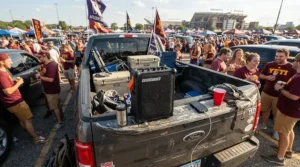
6. JBL PartyBox 110 — 160W with mic and guitar inputs for pregame karaoke
The JBL PartyBox 110 is the friendly middleweight. It delivers 160W RMS through two 5.25-inch woofers and two 2.25-inch tweeters, with a 45Hz–20kHz response (measured at −6dB), IPX4 splash protection and up to 12 hours of playtime. The speaker weighs about 23 pounds and includes an AC cord for unlimited playback when you’re near power.
That −6dB reference matters. It’s a looser yardstick than −3dB, so a 45Hz figure here is less flattering than it sounds and arguably more honest about real-world output. In practice, expect bold mid-bass and a satisfying boom, not earth-shaking sub-bass. Mic and guitar inputs plus the light show make it fun for small crews, tailgate karaoke and halftime cover bands.
Retail feedback is generally positive about bass and volume, while buyers describe the battery life as so-so and the price as a little steep for the category.
Pros:
- ✅ Mic and guitar inputs built in
- ✅ AC cord extends playtime near power
- ✅ Bass Boost mode and light show
Cons:
- ❌ 12-hour battery is the shortest here
- ❌ IPX4 only, with no dust protection
Look for roughly $300 (check current price). It’s decent value for smaller gatherings and karaoke-heavy crews.
7. JBL Xtreme 4 — lightest IP67 pick with a swappable battery
The JBL Xtreme 4 is for the tailgater who parks in the next county. At about 4.6 pounds with a shoulder strap, it’s the one you’ll actually carry. Inside are two 30W woofers, two 20W tweeters and passive bass radiators on both end caps. The response is listed at 44Hz–20kHz, the shell is IP67, and the battery is replaceable and rated up to 24 hours.
Smaller cabinets move less air, and that’s the trade. RTINGS observed that JBL’s newer Charge 6 matches its bass output, a compliment to the smaller speaker and a reminder that this is not a JBL PartyBox Stage 320 replacement. What Hi-Fi also warns that Playtime Boost thins the bass, so skip it if low end is the point. The bonus is Auracast, which lets you link compatible JBL speakers for a bigger wall of sound.
Reviewers consistently highlight clear mids and highs, and mention the weight and price as the main drawbacks.
Pros:
- ✅ IP67 in a genuinely carryable size
- ✅ Replaceable battery and 24-hour claim
- ✅ Auracast pairing for expansion
Cons:
- ❌ Smaller cabinet can’t match big party boxes
- ❌ Reviewers flag the premium price
Expect roughly $300-$380 depending on promotions (check current price). It’s best when portability tops your list.
Here’s how the seven stack up on hardware.
| Pick | Bass Hardware | Approx. Weight | IP Rating | Best For |
|---|---|---|---|---|
| JBL PartyBox Stage 320 | Large cabinet, 240W, ~40Hz listed | ~36 lb | IPX4 | Big crowds with wheels |
| Sony ULT Field 7 | Bass-reflex ports, ULT1/ULT2 modes | ~14 lb | IP67 | Wet weather |
| Ultimate Ears Hyperboom | 2 woofers + 2 passive radiators | ~13-15 lb | IPX4 | Wide, loud sound |
| Bose SoundLink Max | 3-driver array + 2 passive radiators | Mid-weight, rope handle | IP67 | Balanced bass |
| Soundcore Boom 2 Plus | 2 woofers + 2 passive radiators | ~8.4 lb | IPX7 | Best budget bass |
| JBL PartyBox 110 | 2×5.25″ woofers, 160W RMS | ~23 lb | IPX4 | Karaoke crews |
| JBL Xtreme 4 | 2 woofers + end-cap radiators | ~4.6 lb | IP67 | Long carries |
Read the table with your arms in mind. Weight and bass roughly rise together, so the heaviest options (JBL PartyBox Stage 320, JBL PartyBox 110) give the deepest authority, while JBL Xtreme 4 and Soundcore Boom 2 Plus deliver more bass per pound than their size suggests. If dust and rain matter, only the IP67 trio and the IPX7 Soundcore Boom 2 Plus offer real armor.
How to Choose a Tailgate Party Speaker With Deep Bass
- Count your crowd. Under 10 people, a compact IP67 model is plenty. Between 10 and 30, step up to a mid-size box. Beyond 30, a wheeled cabinet earns its keep.
- Read bass specs skeptically. Look for a published low-end figure and its reference point (−3dB or −6dB), not just wattage.
- Inspect the bass hardware. Larger woofers and passive radiators move more air than a single small driver with a “boost” sticker.
- Match protection to your climate. IPX4 handles drizzle. IP67 and IPX7 handle sloppy, gritty reality.
- Budget battery honestly. Claims assume moderate volume. Lights, bass modes and phone charging all cut runtime.
- Plan the carry. Weight beats wattage when your car is a half-mile away.
- Look for pairing. Auracast, Party Connect and PartyCast let you add a second speaker later.
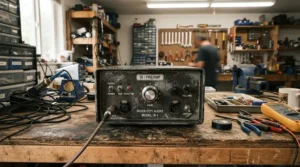
Passive Radiator vs Subwoofer: Choosing a Rugged Outdoor Party Speaker With Subwoofer Power
The phrase rugged outdoor party speaker with subwoofer sounds like one clear category, but in practice most portable speakers don’t contain a dedicated subwoofer. They use woofers plus either ports or a passive radiator.
A passive radiator looks like a woofer but behaves like a port. According to Parts Express, it’s an undriven cone whose resonance depends on its mass and suspension, and adding mass lowers its resonant frequency. It lets designers get low-tuned bass from much smaller enclosures, and it avoids the pipe resonance that long ports can introduce. The drawback is that below the tuning frequency, output falls off quickly, which is why tiny enclosures need protection at extremes.
Why this matters outdoors: passive radiators have no open tube to collect crumbs, and they keep bass output strong in compact shells. Among our picks, Ultimate Ears Hyperboom, Bose SoundLink Max, Soundcore Boom 2 Plus and JBL Xtreme 4 use them, while TechRadar says Sony ULT Field 7 relies on bass-reflex ports. Interestingly, the older Soundcore Boom 2 used a single 50W racetrack subwoofer, and the Plus swapped it for dual woofers.
The takeaway is simple. Cabinet volume and driver area drive bass output, so don’t chase the label.
Low Frequency Extension Explained: How Deep Is Deep?
Low frequency extension is the lowest note a speaker can reproduce at a useful level. A lower number means deeper bass, but only if you know how it was measured. A −3dB point is a strict yardstick. A −6dB point is looser, and quoted flatter responses (such as 40Hz–40kHz) often leave the tolerance unstated.
Here’s how the listed numbers read. JBL PartyBox Stage 320 lists about 40Hz and Soundcore Boom 2 Plus lists 40Hz. JBL Xtreme 4 is quoted at 44Hz, and JBL PartyBox 110 at 45Hz with a −6dB reference. Sony lists a broader 20Hz–20kHz range for the Sony ULT Field 7, but marketing ranges and measured extension aren’t the same thing.
Why it matters outdoors: many modern bass notes sit in the 40 to 60Hz zone, so speakers reaching that range feel physically powerful at a tailgate. Below that, the open air swallows most of what a portable can produce. Prioritize solid output from 50 to 100Hz over bragging-rights numbers, because that’s where kick drums live.
Dust and Splash Resistance: What IPX4, IPX7 and IP67 Mean for Tailgating
Ingress Protection codes come from the IEC 60529 standard, explained clearly on Wikipedia. The first digit covers solids like dust, and the second covers liquids. An “X” means that category wasn’t tested.
IPX4 means splashing water from any direction shouldn’t cause harm. That’s JBL’s rating on the JBL PartyBox Stage 320, JBL PartyBox 110 and the Ultimate Ears Hyperboom. It says nothing about dust, grit or ash. IPX7 means temporary immersion, up to about a meter for 30 minutes, which fits the Soundcore Boom 2 Plus. IP67 adds full dust-tightness to that immersion rating, covering Sony ULT Field 7, Bose SoundLink Max and JBL Xtreme 4.
Three practical points follow. First, ports and covers must be sealed for the rating to hold, and Sony and Soundcore both stress closing their flaps. Second, ratings are tested in clean fresh water, so sticky drinks and salty air deserve a quick rinse afterward. Third, if your tailgate happens on gravel or a dusty field, dust and splash resistance with a real dust rating is worth paying for.
Bass Boosted Speaker for Tailgating: Features That Actually Matter (And Those That Don’t)
A bass boosted speaker for tailgating can be brilliant or just a muddy gimmick, and the difference is in the details.
What matters:
- Sensible bass modes. Useful ones add low-end weight without choking the mids, like Sony’s dual ULT settings.
- App EQ. If factory tuning runs heavy (as reviewers found with the Bose SoundLink Max), you need a way to trim it.
- Honest battery. Sony’s own Field 5 listing cites around 25 hours with lights off but roughly 10 with them on, a great example of how features eat runtime.
- Pairing. Add a second speaker later instead of replacing the first.
- Carry hardware. Wheels, rope handles and straps matter more than light shows.
What doesn’t:
- Peak wattage numbers. Cabinet design and tuning matter more.
- Playtime Boost. On the JBL Xtreme 4, reviewers say it thins out the bass.
- Light shows. Fun for photos, but they burn battery.
Tailgate Party Speaker With Deep Bass vs Traditional Alternatives
| Option | Bass Strength | Weather Tolerance | Setup | Best For |
|---|---|---|---|---|
| Dedicated tailgate party speaker with deep bass | Strong, tuned for open air | Built for it (IPX4 to IP67) | Press power | Most tailgaters |
| Car stereo with doors open | Decent, but tied to your vehicle | Depends on the car | Engine or battery risk | Casual background music |
| Small pocket Bluetooth speaker | Weak outdoors | Often decent | Instant | Solo or tiny groups |
| Portable PA speaker | Voice-focused | Varies widely | Mixer and cables | Announcements and bands |
The table tells a clear story. Your car stereo ties the party to your vehicle’s battery and your parking spot, and small pocket speakers run out of air-moving ability fast in the open. A dedicated tailgate party speaker with deep bass is the only option combining portability, weather tolerance and real bass, which is exactly why this category exists.
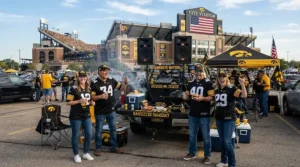
Setup Guide: Placement, EQ and Battery Tricks Amazon Listings Skip
Where you put the speaker matters nearly as much as which one you buy.
Placement. Bass gets stronger near hard surfaces. Set the speaker on a truck tailgate or bed floor, not on a tall tripod in open air. Aim it at your crowd, and keep it off soft cushions that swallow low frequencies.
EQ. Start flat, then add the bass mode. If the sound turns boomy, reduce bass by a few steps in the app. Leave 15 to 20 percent of volume headroom, because compression near maximum is a recurring complaint with big-bass models.
Battery. Charge fully the night before, then lower the lights if you want longer runtime. If your speaker supports AC (like the JBL PartyBox 110), bring the cord for tailgates near power.
First 30 days.
- Close port covers firmly after every use, or your IP rating means nothing.
- Don’t leave it baking in a hot trunk.
- If you won’t use it for weeks, Soundcore suggests recharging every three months.
✨ Ready to Upgrade Your Game Day Sound?
🔍 Take your tailgate to the next level with these carefully selected speakers. Click on any highlighted product name to check current pricing and availability. These picks will help you create game-day memories your whole crew will love!
Real-World Scenarios: Three Tailgaters, Three Different Picks
These are illustrative profiles, not personal testimonials.
The college crew (8-10 friends, tight budget). The lot is a half-mile walk, games happen weekly, and the budget stays under $250. Soundcore Boom 2 Plus gives IPX7 protection, real bass and a strap, while JBL Xtreme 4 is the lighter step up if funds allow.
The family-and-neighbors lot (30+ people). A pickup truck, season-ticket loyalty and a monthly big game. Here a wheeled cabinet pays off. JBL PartyBox Stage 320 handles the crowd, and JBL PartyBox 110 works if the group trends smaller and karaoke matters.
The rain-prone region (concerts and football, any weather). Gravel lots, sticky spills and unpredictable skies mean protection comes first. Sony ULT Field 7 brings IP67 armor and powerful bass modes, while Bose SoundLink Max is the pick for more refined, mixed-genre playlists.
Problem → Solution Guide for Tailgate Bass
Problem: the bass disappears outdoors. Move the speaker near a hard surface and aim it at the crowd. A larger-cabinet model like JBL PartyBox Stage 320 helps most.
Problem: the battery dies before the post-game. Turn off lights, avoid Playtime Boost and bring a backup. A swappable battery (JBL Xtreme 4, JBL PartyBox Stage 320) or AC power (JBL PartyBox 110) solves it.
Problem: sound turns muddy at high volume. Back off 10 to 15 percent and trim bass in the app. This is especially useful with Sony ULT Field 7 and Bose SoundLink Max.
Problem: spills, dust and drizzle. Choose IP67 or IPX7 (Soundcore Boom 2 Plus, Sony ULT Field 7), close every cover and rinse after messy sessions.
Hearing Safety and Tailgate Etiquette
Loud bass feels great, but ears don’t regrow. The CDC’s NIOSH guidance sets a recommended exposure limit of 85 A-weighted decibels averaged over eight hours, and each 3dB increase halves the safe listening time. One independent review measured the Ultimate Ears Hyperboom above 100dB, so standing right next to a speaker like that for hours isn’t wise. Keep a few steps of distance, and take breaks away from the speaker.
Etiquette matters too. Many venues have lot rules and neighbors share the space, so check local policies and turn the bass down when the crowd thins.
Frequently Asked Questions
❓ How loud does a tailgate speaker need to be?
❓ Can I pair two tailgate speakers for more bass?
❓ Does a bass boosted speaker for tailgating drain battery faster?
❓ Should I buy one big speaker or two smaller ones?
❓ Is a hot car trunk safe for a tailgate speaker?
Conclusion
Picking the right tailgate party speaker with deep bass comes down to honest trade-offs. If your crowd is big and your arms are strong, JBL PartyBox Stage 320 delivers the most authority. For unpredictable skies, Sony ULT Field 7 and Bose SoundLink Max bring IP67 protection with distinctly different bass personalities. Ultimate Ears Hyperboom offers wide, loud sound, and JBL PartyBox 110 is the karaoke-friendly middleweight. JBL Xtreme 4 wins the carry test, and Soundcore Boom 2 Plus is the budget bass bargain.
Whatever you choose, read bass specs critically, match dust and splash resistance to your lot, and place the speaker smartly. Low frequency extension, passive radiators and honest battery math matter more than any wattage headline. A little planning turns a decent speaker into the soundtrack of the whole day.
Recommended for You
- Swappable Battery Party Speaker for All-Day Events: 7 Best Picks 2026
- Large Party Speaker With Wheels for Backyard: 7 Epic Picks 2026
- Party Speaker With Microphone and Guitar Input: 7 Best Picks 2026
Disclaimer: This article contains affiliate links. As an Amazon Associate, I earn from qualifying purchases. If you purchase products through these links, we may earn a small commission at no additional cost to you.
✨ Found this helpful? Share it with your friends! 💬🤗
