
In This Article
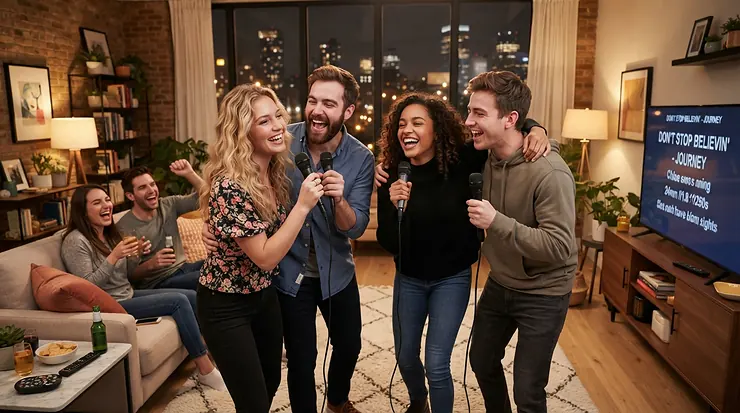
Picture the moment. Somebody grabs a mic, the playlist lands on the one chorus everybody secretly knows, and the speaker either hisses, clips, or quietly gives up. That gap separates a plain Bluetooth box from a party speaker with microphone and guitar input.

The second kind has a real input panel. You plug in a singer, a strummer, or a toast-giving uncle, and the speaker blends their sound with your playlist. Many models add echo, bass and treble controls so the vocals don’t sound like they were recorded in a bathroom (unless that’s the vibe).
Here’s a transparency note before we dive in. Everything below comes from manufacturer spec sheets, retailer listings, and published review sentiment. It does not come from my own bench time, and I’ll flag it whenever a data point is thin. Specs were checked in October 2026, and prices shift constantly, so treat every price range as a starting point and check current pricing.
One quick vocabulary check helps. Most speakers here use a quarter-inch phone connector for mics and guitars, the same jack on a classic electric guitar cable. That detail matters later, when we get into XLR, line-in mixers and mic echo control.
Quick Comparison: Party Speaker With Microphone and Guitar Input at a Glance
| Product | Output (RMS) | Rated Battery | Mic/Guitar Inputs | Mic Included? | Price Range | Best For |
|---|---|---|---|---|---|---|
| JBL PartyBox Club 120 | 160W | Up to 12 hrs | 1 mic + 1 switchable mic/guitar | No (sold separately) | ~$300–$450 | Living rooms and patios |
| Soundcore Rave 3S | 200W | Up to 12 hrs | 1 mic/guitar (6.35 mm) | Yes, 2 wireless | Mid-$300s | Karaoke-first households |
| Sony ULT FIELD 7 | Not published | Up to 30 hrs (volume-dependent) | 1 mic/guitar (6.3 mm) | No | ~$400–$500 | Beaches, pools, camping |
| JBL PartyBox Stage 320 | 240W | Up to 18 hrs | 2 (mic + mic/guitar) | No | ~$450–$600 | Big yards and crowds |
| JBL PartyBox Encore Essential 2 | 100W | Up to 15 hrs | 1 combo guitar/mic | No | ~$230–$330 | Budget solo performers |
| JBL PartyBox Encore 2 | 100W | Up to 15 hrs | 1 guitar + pre-paired wireless mic | Yes, 1 wireless | ~$300–$400 | Small-room karaoke |
| Sony ULT TOWER 10 | Not confirmed | None (mains only) | 1 mic/guitar (6.3 mm) | Yes, 1 wireless | ~$1,000–$1,500 | A permanent party spot |
Looking at the comparison above, the Soundcore Rave 3S is the only model that ships with two wireless mics, which makes it the lowest-friction karaoke buy. The JBL PartyBox Stage 320 brings the most rated output and the second-longest battery. Budget buyers should note that the JBL PartyBox Encore Essential 2 keeps costs down by skipping the microphone entirely, so you’ll want to price one in.
💬 Just one click — help others make better buying decisions too!😊
Top 7 Party Speaker With Microphone and Guitar Input Picks: Expert Analysis
I picked these seven to cover budget, mid-range and premium tiers, and to include both wired-input and wireless-mic philosophies. Each entry decodes what the spec sheet means in a real living room or backyard.
1. JBL PartyBox Club 120 — best all-rounder for living rooms and patios
The headline is the input panel. You get a dedicated mic jack plus a switchable mic/guitar jack, so a singer and a guitarist can plug in at the same time.
Under the grille sit two 5.25-inch woofers and two 2.25-inch tweeters pushing 160W RMS, with a 40Hz–20kHz response. In plain English, that’s comfortable for a living room or a patio of about twenty guests. The rated 12 hours covers a full evening, and the replaceable battery means a spare can swap in mid-party. IPX4 splash resistance handles spilled drinks, not a pool dive.
Here’s the catch. JBL sells its wireless mics separately, using a dongle in the mic jack, so the “karaoke-ready” price runs higher than the sticker.
Retail listings showed very high average ratings at the time of research. Recurring complaints in aggregated feedback include low mic input gain, muddy mic audio through non-JBL mixers, and coarse volume-knob steps. One retailer reviewer also wished the roughly 24-pound body had wheels.
Pros:
- ✅ Two inputs, including a switchable mic/guitar jack
- ✅ Replaceable battery for marathon nights
- ✅ App control of EQ, echo and lighting
Cons:
- ❌ Wireless mics cost extra
- ❌ About 24 pounds with no wheels
Expect roughly the $300–$450 range depending on sales. That’s strong value if you want two real inputs without tower-sized money.

2. Soundcore Rave 3S — AI vocal removal and two wireless mics in the box
Most speakers make you shop for microphones. This one hands you two wireless mics and a remote, which removes the most annoying step of setting up karaoke.
The numbers: 200W output, up to 12 hours of battery, IPX4 splash resistance, and about 21.6 pounds before the mics. Inputs include a 3.5 mm AUX and one 6.35 mm mic/guitar jack. The headline trick is AI vocal removal, which strips the original singer from streamed songs so you’re not hunting for backing tracks.
Based on the spec comparison, this is the pick for karaoke-first households. The trade-off is that the single wired jack makes a guitar and a wired mic compete for one slot. The wireless mics solve the vocal side of that, but you can’t run a full band through it.
Digital Trends praised the included wireless mics and said the vocal removal works well. On Soundcore’s own site, 91% of 79 reviews were five-star, though brand-hosted reviews deserve a grain of salt.
Pros:
- ✅ Two wireless mics and remote included
- ✅ AI vocal removal builds karaoke tracks
- ✅ Strong 200W output for its size
Cons:
- ❌ Only one wired mic/guitar jack
- ❌ No replaceable battery advertised
Plan for the mid-$300s range. That’s very good value, since the mics alone would add real money to rival picks.
3. Sony ULT FIELD 7 — IP67 toughness and the longest battery rating
Where the others are IPX4, this one is IP67, meaning it’s built to survive dust and a dunk. That’s why it’s the beach, pool and campsite candidate.
Sony rates it at up to 30 hours, with a 10-minute quick charge adding about 3 hours. Per Tom’s Guide, that figure assumes volume around 25% with LEDs and ULT bass off, and enabling ULT mode can drop runtime to about 7 hours. Treat 30 hours as a ceiling, not a promise.
It weighs about 14 pounds and has a single quarter-inch mic/guitar input with a gain knob. The standout is the rear panel, with physical Echo and Key buttons you can adjust by feel in the dark, plus a Guitar toggle.
On paper this means the best mic echo control of the group for people who hate opening apps. The trade-off is one shared input and no wireless mic in the box.
Tom’s Guide called it a solid party speaker with big sound. One retailer reviewer loved the jack but wanted a swappable battery.
Pros:
- ✅ IP67 dust and water resistance
- ✅ Physical Echo and Key buttons
- ✅ 10-minute charge adds roughly 3 hours
Cons:
- ❌ One shared mic/guitar jack
- ❌ Real battery life falls well below 30 hours at party volume
Expect about the $400–$500 range. It’s worth it if durability and portability top your list.
4. JBL PartyBox Stage 320 — wheels, 240W and 18 hours for big yards
Thirty-six pounds is not carry-in-one-hand territory, which is exactly why the telescopic handle and wheels exist.
You get 240W RMS from two 6.5-inch woofers and two 1-inch tweeters, a rated 18 hours of battery, and a replaceable battery pack. For a backyard of forty-plus guests, that extra headroom over 100–160W models is the difference between “background music” and “everyone can hear the toast.” Dual mic/guitar inputs let two performers plug in at once. One spec database lists a quarter-inch TRS mic jack and a TRS guitar/mic jack. There are also AUX and RCA inputs and a USB port that charges phones.
Here’s what the spec sheet won’t highlight: you’re paying for scale. At this weight, the Stage 320 only makes sense if wheels, outdoor range and battery longevity matter more than portability.
A Sweetwater reviewer praised the mic and guitar inputs, the long battery, and the phone-charging port. Independent long-term complaint data was thin, so I can’t summarize more than that.
Pros:
- ✅ 240W RMS fills large yards
- ✅ Wheels and telescopic handle
- ✅ Up to 18 hours, swappable battery
Cons:
- ❌ Over 36 pounds
- ❌ Quarter-inch TRS inputs rather than XLR combos
Roughly the $450–$600 range is typical. It’s good value for outdoor crowds, and overkill for apartments.
5. JBL PartyBox Encore Essential 2 — lightest budget pick with a combo guitar/mic jack
Smaller, cheaper, and the lightest of the seven at about 13.7 pounds. It keeps one quarter-inch combo guitar/mic input and drops most of the extras.
The specs: 100W RMS from a 5.25-inch woofer and two tweeters, a 34Wh replaceable battery, IPX4, Bluetooth 5.4, and stereo pairing or Auracast linking. JBL’s own mic table says it supports one wired mic or two wireless mics via a dongle, but no mic ships in the box.
Here’s what to weigh. At 100W, this fits a patio of a dozen friends or a mid-sized room, not a crowd. The 15-hour claim assumes moderate volume. One buyer on a retailer page reported around 6 hours at loud levels.
Reviewers on retail pages describe small size and big sound, and one noted that using the speaker as a PA worked well. Listings averaged around 4.8 stars at the time of research.
Pros:
- ✅ Lightest at about 13.7 pounds
- ✅ Replaceable 34Wh battery
- ✅ Stereo pairing and Auracast support
Cons:
- ❌ One input only
- ❌ No microphone in the box
Plan on roughly $230–$330. For the cost of two cinema tickets, it’s the cheapest way into live vocals.
6. JBL PartyBox Encore 2 — pre-paired wireless mic in the box
If your goal is “unbox, press a button, sing,” this is the simplest route here. The digital wireless mic comes pre-paired.
The speaker delivers 100W RMS, up to 15 hours of playback, and a replaceable battery. The mic is the real story: up to 10 hours of runtime, range up to about 100 feet, AES-128 encryption, and latency under 12 ms. Low latency matters because a lagging mic is the fastest way to make a singer feel like their voice belongs to someone else. JBL also lists adjustable echo, bass and treble for the mic.
There’s a wiring detail worth knowing. JBL notes that a wired mic plugged into the guitar input bypasses the karaoke effects, including echo, so the effects chain is designed around the wireless mic.
Independent user-review data was thin at the time of research, so I can’t verify a clear consensus. A listicle ranked it best for affordable home karaoke, with weight as the trade-off.
Pros:
- ✅ Pre-paired wireless mic included
- ✅ Echo, bass and treble adjustments for the mic
- ✅ Wireless range up to about 100 feet
Cons:
- ❌ Only 100W RMS
- ❌ Wired mics skip echo on the guitar jack
Expect roughly the $300–$400 range. It’s a solid value for small-room karaoke.
7. Sony ULT TOWER 10 — living-room tower with a wireless mic and echo/key controls
This one is less speaker and more furniture. It stands about 110 cm tall, weighs roughly 29 kg (about 64 pounds), has no battery, and runs only on mains power.
Its draw is the mic story: a wireless mic is included, a second input accepts a mic or guitar, and the top panel carries Echo and Key controls. Sony also pitches 360-degree sound and light, optical input, a USB-A power-bank port, and a TV Sound Booster mode.
Computer Bild scored it 79/100, praising the light show, the connections and the included mic, while criticizing distortion at high volume and the lack of a battery. A Coolblue reviewer found the small hard wheels awkward on pavement.
That makes it a fixture, not a portable. If you want a basement bar or rec-room centerpiece that doubles as a TV booster, it fits. If you want to carry it to the park, it doesn’t.
Pros:
- ✅ Wireless mic included
- ✅ Echo and Key controls on the top panel
- ✅ Doubles as a TV sound booster
Cons:
- ❌ No battery, wall outlet required
- ❌ Roughly 64 pounds
Prices vary widely by region, so expect something like $1,000–$1,500 and check current price. Pay only if it will live in one room.
The table below shows what the weight and durability trade-offs look like side by side.
| Product | Weight | Water/Dust Rating | Battery | Best For |
|---|---|---|---|---|
| JBL PartyBox Club 120 | ~24.4 lb | IPX4 | Replaceable, up to 12 hrs | Two-input home parties |
| Soundcore Rave 3S | ~21.6 lb (excl. mics) | IPX4 | Up to 12 hrs | Karaoke with no extra shopping |
| Sony ULT FIELD 7 | ~14 lb | IP67 | Up to 30 hrs (volume-dependent) | Beach, pool, camping |
| JBL PartyBox Stage 320 | ~36.4 lb | IPX4 | Replaceable, up to 18 hrs | Large outdoor crowds |
| JBL PartyBox Encore Essential 2 | ~13.7 lb | IPX4 | Replaceable, up to 15 hrs | Light carrying, small groups |
| JBL PartyBox Encore 2 | ~14.1 lb | IPX4 | Replaceable, up to 15 hrs | Plug-and-sing karaoke |
| Sony ULT TOWER 10 | ~64 lb | Splashproof top surface | None (mains only) | Fixed basement or rec-room setups |
If you move your speaker often, the JBL PartyBox Encore Essential 2 and the Sony ULT FIELD 7 sit around 14 pounds and are the easiest to carry. The JBL PartyBox Stage 320 and Sony ULT TOWER 10 trade portability for volume and presence. The Sony ULT FIELD 7 is the only one built for submersion-level abuse.
What Is a Party Speaker With Microphone and Guitar Input?
A party speaker with microphone and guitar input is a battery or mains-powered loudspeaker that streams music over Bluetooth while also accepting a live microphone or instrument through dedicated jacks, usually quarter-inch. Built-in mixing blends your voice or guitar with playback, often with echo and bass controls, so one box covers karaoke, speeches, and casual jam sessions.
That’s different from a speakerphone, where the mic only serves calls. It’s also different from a full PA system, which offers more input types and finer control but costs more and weighs more.
The three inputs deserve plain-language definitions, because they sit at different signal levels. On JBL’s published specs, for example, Mic-In is rated at 20 mV RMS, Guitar-In at 100 mV RMS, and Aux-In at 370 mV RMS. In practice, the mic input is the most sensitive, the guitar input expects a stronger instrument signal, and AUX expects a line-level signal from a phone or mixer. Plugging the wrong source into the wrong jack is the root of most “why does this sound awful?” moments.

How to Choose a Party Speaker With Microphone and Guitar Input
- Count the inputs you actually need. A solo singer needs one jack; a singer-plus-guitarist duo needs two, or a wireless mic plus a wired guitar jack.
- Decide whether a wireless mic must be included. Included mics (Soundcore Rave 3S, JBL PartyBox Encore 2, Sony ULT TOWER 10) save money, but add-on systems offer more flexibility.
- Match output to your crowd. Roughly, 100W suits small rooms, 160–200W suits mid-sized spaces, and 240W-plus suits yards and larger gatherings.
- Be skeptical about battery claims. Rated hours assume moderate volume, so plan on far less at loud levels.
- Weigh the weight honestly. If you’ll carry it up stairs, 14 pounds and 36 pounds are very different experiences.
- Check weather resistance. IPX4 means splashes, IP67 means serious dust and water protection.
- Look for echo control you can reach. Physical buttons beat menus when the room is dark and the singer is mid-chorus.
Portable Speaker With Mic and Guitar Jacks: What Portability Really Costs
A portable speaker with mic and guitar jacks sounds like a free lunch, but the lunch has a weight. The seven picks range from about 14 pounds to roughly 64 pounds, and that difference reshapes how you use the speaker.
Battery-powered options let you perform anywhere, including parks, driveways and campsites. Replaceable batteries on the JBL models mean a spare can keep the music going. Sealed-battery designs like the Sony ULT FIELD 7 rely on quick charging instead, with 10 minutes adding about 3 hours.
| Option | Mic/Guitar Inputs | Portability | Typical Cost | Best For |
|---|---|---|---|---|
| Party speaker with mic/guitar jacks | 1–3 inputs | Medium to heavy | ~$230–$600 | JBL PartyBox Club 120 and Soundcore Rave 3S buyers |
| Small PA system | Multiple, often XLR | Medium | Varies widely | Frequent live performers |
| Dedicated karaoke machine | Usually 1–2 mic jacks | Light to medium | Varies widely | Karaoke-only households |
| Basic Bluetooth speaker | None | Light | Lower | Background music only |
The table says something simple: a party speaker with mic and guitar jacks hits the middle of the market. It beats a basic Bluetooth speaker on live-performance ability and a small PA on simplicity. If you routinely need three or more inputs or balanced XLR connections, you’ve outgrown this category.
Karaoke Party Speaker With Wireless Mic: Included vs Add-On
The phrase karaoke party speaker with wireless mic hides a cost question. Three of the seven include a mic (Soundcore Rave 3S with two, JBL PartyBox Encore 2 with one, Sony ULT TOWER 10 with one), and the rest need one.
For JBL’s other models, the add-on route works through a wireless mic set whose dongle plugs into the mic input. JBL’s own table says the JBL PartyBox Club 120 and JBL PartyBox Stage 320 can run one wired mic plus two wireless mics at once. The JBL PartyBox Encore Essential 2 supports one wired or two wireless, not both.
Here’s how I’d weigh it. If you sing at every gathering, a karaoke party speaker with wireless mic in the box is simpler and often cheaper overall. If you only occasionally need a mic, buying the cheaper speaker and adding a wired mic later keeps your options open. Also check the mic’s own battery. The JBL PartyBox Encore 2 mic is rated at up to 10 hours, which comfortably covers a night but needs charging before the next.
Combo XLR Quarter-Inch Input: What It Is and Who Actually Needs One
A combo XLR quarter-inch input is a single jack that accepts either a three-pin XLR plug or a quarter-inch plug. According to Wikipedia’s XLR connector entry, XLR is the industry standard for balanced audio, most professional microphones use it, and manufacturers such as Neutrik and Amphenol make combination connectors that take both XLR and 6.5 mm phone plugs.
Now the honest part. None of the seven picks above are confirmed in my sources to have a combo XLR quarter-inch input. They use quarter-inch jacks. One spec database lists the larger JBL PartyBox 720 (800W RMS, two 9-inch woofers) with TRS/XLR inputs, so if XLR matters, verify that model’s current specs with the seller.
If you own an XLR mic, you aren’t stuck. An XLR-to-quarter-inch cable converts the plug, but the speaker input remains unbalanced, so keep cable runs short. None of the spec sheets I found mention phantom power, so assume dynamic mics only, not condenser mics that need 48V.
Mic Echo Control: A Practical Setup Guide for Cleaner Vocals
Mic echo control is the difference between “polished karaoke” and “cave singer.” Here’s a reliable setup routine.
- Set the mic level first. Raise the mic volume until your normal speaking voice sits slightly below the music.
- Start echo low. Begin near the bottom of the range and add gradually, since a little echo flatters, and a lot muddies words.
- Balance the mix. Keep the music slightly under the vocal for karaoke, and reversed for background mingling.
- Mind placement. Stand beside or behind the speaker, never in front of it, to avoid squeal.
Each model handles this differently. The Sony ULT FIELD 7 and Sony ULT TOWER 10 put physical Echo and Key controls on the panel. The JBL PartyBox Club 120 moves echo into the app, where a firmware update raised bass, treble and echo adjustment from 6 to 12 levels. The JBL PartyBox Encore 2 offers adjustable echo, bass and treble for its wireless mic, but a wired mic on its guitar input skips those effects.
Troubleshooting is simple. If you hear squeal, move away from the speaker or lower the mic volume. If vocals sound muddy, cut echo and bass. If words get lost, raise treble slightly.
Line-In Mixer: Connecting a Small Mixer to Your Party Speaker
A line-in mixer setup solves the “I need five inputs and the speaker has one” problem. Plug two mics, a guitar and a phone into a small mixer, then feed its stereo output into the speaker.
The critical rule is to use the AUX or line input, not the mic or guitar jack. Remember the sensitivities from earlier: JBL lists Mic-In at 20 mV, Guitar-In at 100 mV, and Aux-In at 370 mV. A mixer’s output is line-level, so sending it into the mic jack risks distortion, while the AUX input expects exactly that signal strength.
Here’s a clean routine for a line-in mixer.
- Turn the speaker volume low and the mixer master near three-quarters.
- Connect a 3.5 mm cable from the mixer’s main output to the speaker’s AUX in.
- Raise channel levels one at a time until nothing clips, then raise the speaker volume.
Expect one trade-off. Because the line-in mixer feeds the AUX input, the speaker’s own mic effects, such as the JBL PartyBox Club 120 app echo, won’t apply, so use the mixer’s built-in reverb instead. Models with AUX inputs include the Soundcore Rave 3S, JBL PartyBox Stage 320 and Sony ULT TOWER 10.

Real-World Scenarios: Which Party Speaker Fits Your Night
The apartment karaoke crew. Six friends, one living room, zero patience for pairing mics. The Soundcore Rave 3S or the JBL PartyBox Encore 2 gets you singing in minutes, and neither is too loud for neighbors at moderate volume.
The backyard barbecue with a guitarist. Forty guests and one uncle with an acoustic. The JBL PartyBox Stage 320 brings the power and wheels, while the JBL PartyBox Club 120 is the lighter alternative for a smaller crowd.
The beach, pool or campsite singalong. Sand, spray and no wall outlet. The Sony ULT FIELD 7, with IP67 protection and the longest rated battery, is the natural fit.
The basement bar. If the speaker never leaves the room, the Sony ULT TOWER 10 adds a TV booster mode. If budget rules, the JBL PartyBox Encore Essential 2 with a cheap wired mic gets you started.
✨ Don’t Miss These Top Picks!
🔍 Take your next karaoke night or backyard jam to the next level with these carefully selected speakers. Click on any highlighted item to check current pricing and availability. These picks will help you create unforgettable party moments your friends will talk about!
Features That Actually Matter (And Those That Don’t)
What matters: the number and type of inputs, honest battery runtime at party volume, accessible echo control, weight, and weather resistance. These shape what you can do on the night.
What matters less: lightshow settings, Bluetooth version numbers, and color options. A beat-synced light ring is fun for a minute, then you’re back to wondering whether the singer can be heard.
Be especially cautious about wattage comparisons. Output ratings aren’t always measured the same way, so the JBL PartyBox Stage 320 at 240W RMS and Soundcore Rave 3S at 200W aren’t guaranteed to differ audibly in a living room. What matters more is headroom: at similar volume, a bigger speaker strains less.
Common Mistakes When Buying a Party Speaker With Microphone and Guitar Input
- Plugging a mixer into the mic jack. That’s a level mismatch, as the line-in mixer section explained.
- Trusting the headline battery number. The Sony ULT FIELD 7 is the clearest example of a rated figure that shrinks at real volume.
- Forgetting the microphone budget. The JBL PartyBox Club 120 and JBL PartyBox Encore Essential 2 are cheaper until you add mics.
- Assuming XLR compatibility. Most speakers in this class use quarter-inch jacks.
- Underestimating weight. Thirty-six pounds feels very different at the end of a long carry.
- Expecting condenser mics to work. Without phantom power, many won’t.
Long-Term Cost and Maintenance
Think in cost per party, not sticker price. A speaker in the mid-$300s used at 40 parties costs under ten dollars a night, and that’s before counting the joy.
Battery care matters most. The JBL models use a replaceable battery, and a spare turns a 12–18 hour speaker into an all-weekend one. The mic battery needs charging too, since the JBL PartyBox Encore 2 mic is rated at up to 10 hours. The Sony models include battery-care features, which help if the speaker lives on the charger.
Splash resistance isn’t a swimming license, so wipe spills and keep ports dry. Dust the grille occasionally, update the companion app, and store the speaker somewhere cool.
Hearing Safety: Keeping Party Volume Sane
A powerful speaker makes it easy to forget your ears are a finite resource. According to the CDC’s NIOSH guidance, the recommended exposure limit for workplace noise is 85 A-weighted decibels averaged over eight hours, with allowable time halved for every 3 dB increase. By that math, 100 dB gives you roughly 15 minutes.
That limit is workplace guidance, but the principle carries over. If you have to raise your voice to be heard by someone three feet away, you’re near hazardous territory.
Practical habits help. Keep guests a few feet from the speaker, take volume breaks between songs, and offer foam earplugs to the person standing beside the JBL PartyBox Stage 320 all night. Your neighbors will thank you too.
FAQ
❓ Can I use a wireless mic with a party speaker with microphone and guitar input?
❓ Do I need a line-in mixer for karaoke?
❓ What does mic echo control do?
❓ Can I use an XLR microphone with a portable speaker with mic and guitar jacks?
❓ How long does a karaoke party speaker with wireless mic last on battery?
Conclusion
Choosing a party speaker with microphone and guitar input comes down to matching the box to your night. The Soundcore Rave 3S is the easiest karaoke buy, with two wireless mics and AI vocal removal. The JBL PartyBox Club 120 is the flexible all-rounder, and the JBL PartyBox Stage 320 is the crowd-filler with wheels. The Sony ULT FIELD 7 wins for rugged outdoor use, the JBL PartyBox Encore Essential 2 wins on price and weight, the JBL PartyBox Encore 2 wins on plug-and-sing simplicity, and the Sony ULT TOWER 10 wins as a permanent fixture.
Whatever you pick, remember the lessons from this guide. Put mixers on the AUX input, keep echo gentle, expect real battery life to trail the rated hours, and protect your hearing. If XLR is a must, double-check specs before buying, since none of the seven are confirmed to have a combo XLR quarter-inch input.
✨ Don’t Miss These Top Picks!
🔍 Take your party to the next level with these carefully selected speakers. Click on any highlighted product name to check current pricing and availability. These picks will help you create the authentic, sing-along nights your friends will remember!
Recommended for You
- Swappable Battery Party Speaker for All-Day Events: 7 Best Picks 2026
- Large Party Speaker With Wheels for Backyard: 7 Epic Picks 2026
- Tailgate Party Speaker With Deep Bass: 7 Epic Picks (2026)
Disclaimer: This article contains affiliate links. As an Amazon Associate, I earn from qualifying purchases. If you purchase products through these links, we may earn a small commission at no additional cost to you.
✨ Found this helpful? Share it with your friends! 💬🤗
